
Pool Float Trade Dress Is for the Birds
October 19, 2018
Authored and Edited by Morgan E. Smith; Margaret A. Esquenet; Naresh Kilaru
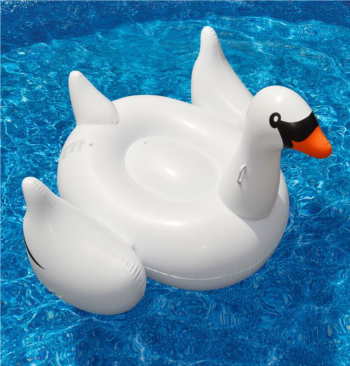
In International Leisure Products Inc. v. Funboy LLC (No. 17-3982, 2d Cir. Sept. 6, 2018), the Second Circuit affirmed the dismissal—with prejudice—of a trade dress action that had been brought to protect bird-shaped pool floats. Noting that trade dress protection (unlike patent and copyright protection) is unlimited in time, the court emphasized that “particular caution” must be exercised in protecting product designs, and that only “distinctive” designs—not “an idea, a concept, or a generalized type of appearance”—deserve protection.
International Leisure Products (“Swimline”) had filed suit against Funboy to protect the design of its “Giant Swan” pool floats (one of which is pictured above). Swimline asserted that its trade dress included these seven elements:
- “circular or elliptical periphery and recessed interior configuration of the inflatable base with a height in proportion to the circumference of the base to provide a pleasing appearance”;
- “substantially vertical inclination and straight line of the ‘neck’ portion projecting from the periphery of the base, the neck having a particular thickness and height to be in aesthetic proportion to the base”;
- “stylized depiction of the head including the face of a bird, possibly resembling a swan, wherein the stylized countenance has two eyes each having a dark periphery and a light or white center, and a bill or beak surrounded by a shaped border that merges with the periphery of the eyes”;
- “elongated tubular shape of the stylized appendages located on opposite sides of the base, with a height and thickness in aesthetic proportion to the base and optional horizontal arcing lines, the stylized appendages being instead of a bird’s wings and also optionally having a generally conical upwardly inclined protuberance”;
- “conical shape of the tail, and the substantially upward inclination of that conical shape from the periphery of the base at the end opposite that from which extends from the neck”;
- “signature color scheme with white, black, gold or pink coloration of the body, orange coloration of the bill/beak and the described coloration of other facial features”; and
- “an overall smooth and flexible texture.”
But in describing its trade dress as “a bird, possibly resembling a swan,” it was apparent that Swimline was not even limiting the protection it sought to swan-shaped floats. (Swimline also sold pool floats shaped like other birds, including flamingos.)
The Second Circuit agreed with the district court that Swimline had not “allege[d] a distinct, non-generic trade dress.” It pointed, in particular, to Swimline’s use of “subjective descriptors” such as “pleasing appearance” and “aesthetic proportion,” and it noted that trade dress should not be protected where it lacks “sufficiently objective identifiers.” Further, the court noted that some of Swimline’s alleged trade dress elements contained “optional” or “alternative” features, and it concluded that it “was difficult to discern in [Swimline’s] description a single distinctive look.”
While Swimline attempted to buttress the written description of its trade dress by pointing to a photograph in its complaint (shown above), the court found the photograph insufficient. Under its case law, the court said, “a visual representation of the asserted trade dress does not excuse ‘the party seeking protection’ from its burden of ‘point[ing] to elements and features that distinguish its trade dress.”
Moreover, the court recognized that the “key consideration” underlying trademark law is “source identification.” Here, though, the court concluded that “a swan-shaped pool float represents the type of design choice that is ‘almost invariably’ intended ‘to render the product itself more useful or more appealing’ rather than to ‘identify the [product’s] source.’” In the court’s view, Swimline “appear[ed] to be seeking protection for a trade dress that would encompass any bird-shaped pool float with even a passing resemblance to [Swimline’s] GIANT SWANTM.” The court thus concluded that Swimline’s claimed trade dress was “impermissibly overbroad” and that Swimline had failed to state a claim for trade dress infringement.
Additionally, Swimline did not dispute that if its trade dress was not protectable, its related claims (of trademark infringement, false designation of origin, unfair competition, and trademark dilution) would fail as well. Accordingly, the Second Circuit also affirmed their dismissal. Moreover, the court affirmed the dismissal of Swimline’s final claim—for unjust enrichment—because Swimline had not alleged that Funboy had “obtained some unfair benefit.”
Finally, the court rejected Swimline’s assertion that its claims should not have been dismissed “with prejudice.” As the court pointed out, Swimline neither sought leave from the district court to file a third amended complaint nor said, in its Second Circuit brief, how it could cure its pleading deficiencies. Thus, the Second Circuit held, the decision to make the dismissals with prejudice was not an abuse of discretion.
Related Practices
Contacts


Copyright © 2018 Finnegan, Henderson, Farabow, Garrett & Dunner, LLP.
DISCLAIMER: Although we wish to hear from you, information exchanged in this blog cannot and does not create an attorney-client relationship. Please do not post any information that you consider to be personal or confidential. If you wish for Finnegan, Henderson, Farabow, Garrett & Dunner, LLP to consider representing you, in order to establish an attorney-client relationship you must first enter a written representation agreement with Finnegan. Contact us for additional information. One of our lawyers will be happy to discuss the possibility of representation with you. Additional disclaimer information.
