
First Amendment A Defense in Rosa Parks Right of Publicity Suit Against Target
April 08, 2015
Authored and Edited by Eleanor Atkins
An Alabama district court recently granted summary judgment for Target Corporation in an action brought by the Rosa and Raymond Parks Institute for Self Development over Target’s sale of certain works featuring Rosa Parks, including commemorative plaques like the one pictured below.
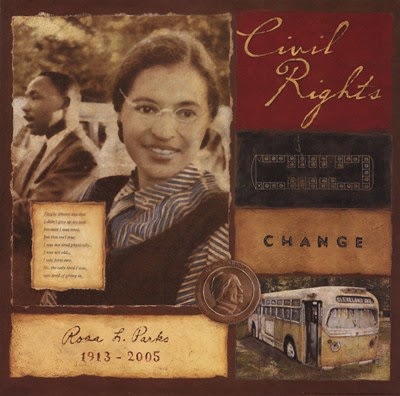
The Rosa and Raymond Parks Institute for Self Development is a non-profit organization that holds the rights to Parks’ name and likeness. It sued Target for right of publicity violations, misappropriation, and unjust enrichment over Target’s sale of DVDs, books, and collage-style commemorative plaques, featuring Rosa Parks. Target moved for summary judgment, arguing that the works were protected by the First Amendment.
Noting that the Rosa and Raymond Parks Institute did not claim any of the biographical information conveyed in these books or DVDs was false, the court said it failed to see how the First Amendment’s protection did not extend to purely biographical accounts of Rosa Parks’ life: “The importance of her story serves as an apt reminder of why First Amendment protection for biographical works is so vital.”
The court applied a separate analysis for the plaques finding they were “less of a biographical work and more akin to a work of art.” This required that the court balance plaintiff’s commercial purpose with First Amendment considerations as to whether the appropriation touched on matters of public interest, the news, or anything else of historical value. Holding that public interest considerations included educational matters, the court said “[t]here can be no doubt that Rosa Parks and her involvement in the Civil Rights movement are matters of utmost importance, both historically and educationally.”
This is not the first lawsuit over the appropriation of Rosa Parks’ name and likeness. In 1999, the Sixth Circuit reversed the district court’s grant of summary judgment for the rap duo Outkast over their use of Rosa Parks’ name in a song entitled “Rosa Parks.” The case was ultimately settled in 2005.
Copyright © 2015 Finnegan, Henderson, Farabow, Garrett & Dunner, LLP.
DISCLAIMER: Although we wish to hear from you, information exchanged in this blog cannot and does not create an attorney-client relationship. Please do not post any information that you consider to be personal or confidential. If you wish for Finnegan, Henderson, Farabow, Garrett & Dunner, LLP to consider representing you, in order to establish an attorney-client relationship you must first enter a written representation agreement with Finnegan. Contact us for additional information. One of our lawyers will be happy to discuss the possibility of representation with you. Additional disclaimer information.