
Surf's up: Is the Federal Circuit Using Rule 36 to Rubber-Stamp the PTAB’s Decisions in IPRs?
November 16, 2015
Authored and Edited by Justin A. Hendrix; Jacob A. Schroeder; Elizabeth D. Ferrill
In our prior post, we explored the ominous predictions from 2013 that the “tsunami” of appeals from IPR decisions would crush the Federal Circuit. Our conclusion was that, for now, the Court appears to be doing just fine. One practice the Court has used so far is consolidation, which allows the Court to combine related appeals that raise similar issues. Another practice the Court has used—Rule 36 judgments after oral argument—reduces the burden imposed by issuing written decisions.
Federal Circuit Rule 36 specifies that “[t]he court may enter a judgment of affirmance without opinion . . . when it determines that any of the following conditions exist and an opinion would have no precedential value.” Those conditions include when “the decision of an administrative agency [such as the USPTO] warrants affirmance under the standard of review in the statute authorizing the petition for review.” Rather than write a time-consuming opinion, the use of Rule 36 allows the Court to dispose of a case with a single-word opinion: “Affirmed.” Rule 36 judgments typically issue within a day or two of the oral argument or, occasionally, the Monday following oral argument week.
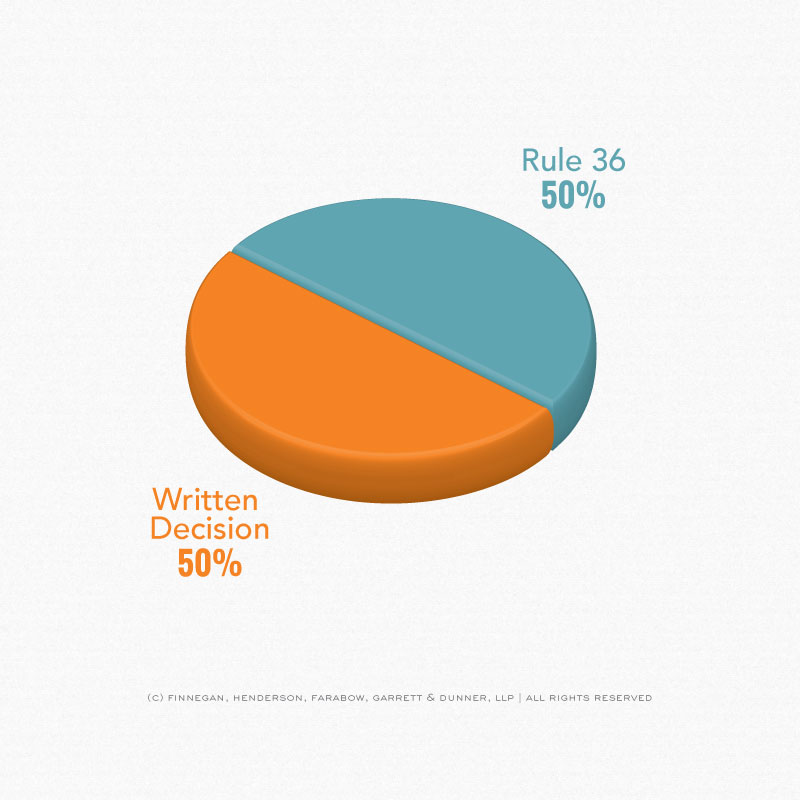
Today’s post considers whether the Court is using Rule 36 as an easy way to rubber stamp the majority of appeals from IPR decisions.[1] Upon first glance, it appears that the Court is doing just that. Since the first decision from an IPR issued, in December 2013, it has issued 42 decisions in appeals from IPRs. Of those, 21 (50%) were Rule 36 summary affirmances.
But these statistics alone do not show the full picture, for they do not account for the number of appeals that have already been argued and are simply awaiting a written decision. As of today, 14 appeals fall into this category. These 14 appeals have already been argued, and enough time has lapsed since the oral argument that they face a low risk of being “Rule 36-ed.” If we assume these will not be “Rule 36-ed,” the number of IPR appeals decided by Rule 36 drops to about a third (37.5%).[2]
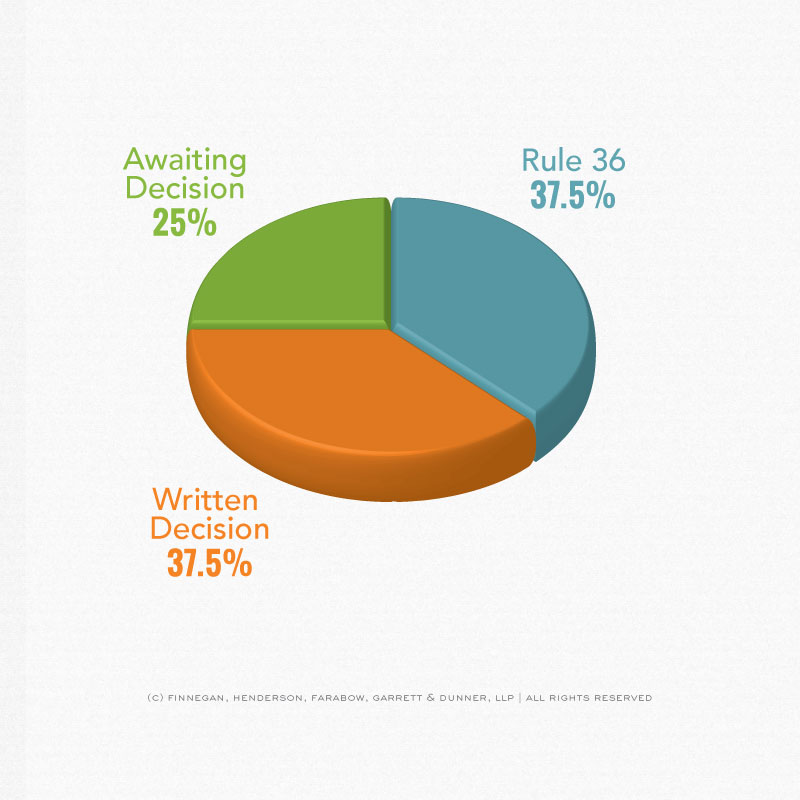
When accounting for these appeals awaiting a written decision, it is clear that the Court is not just using Rule 36 to rubber stamp the PTAB’s decisions in IPR proceedings. Rather, it only appears that way because (1) the Court has only just begun issuing decisions from IPR appeals; and (2) Rule 36 decisions, which are short and non-precedential, can issue quickly whereas the written decisions take time to write and, if precedential, must also be reviewed by the full Court.
In sum, although it appears at first-glance that the Federal Circuit may be summarily affirming an abnormally high number of appeals from IPR decisions, the full picture tells a different story.
[1] For a detailed analysis of the Federal Circuit’s use of Rule 36 in disposing of appeals from PTAB decisions, see this recent article by Anthony Tridico, PTAB Affirmance at the Federal Circuit.
[2] In past years, the Federal Circuit’s Rule 36 rate of decisions from the USPTO has been as high as about fifty percent, as observed by Daniel Cooley, Navigating PTAB Appeals Before the Federal Circuit.
Tags
patentability, Patent Trial and Appeal Board (PTAB), United States Patent and Trademark Office (USPTO)
Contacts


Copyright © 2015 Finnegan, Henderson, Farabow, Garrett & Dunner, LLP.
DISCLAIMER: Although we wish to hear from you, information exchanged in this blog cannot and does not create an attorney-client relationship. Please do not post any information that you consider to be personal or confidential. If you wish for Finnegan, Henderson, Farabow, Garrett & Dunner, LLP to consider representing you, in order to establish an attorney-client relationship you must first enter a written representation agreement with Finnegan. Contact us for additional information. One of our lawyers will be happy to discuss the possibility of representation with you. Additional disclaimer information.