
USPTO’s Boardside Chat Provides Guidance on the New “Workload Management” Bifurcated Discretionary Denial Procedure
April 25, 2025
Authored and Edited by Taryn T. Willett; Timothy P. McAnulty; Forrest A. Jones
Update (April 25, 2025)
On April 25, 2025, the Board published the recording and slides from the Boardside Chat on the USPTO website. The Board also published the promised Frequently Asked Questions for Interim Processes for PTAB Workload Management, including answers to additional questions. We discuss the FAQ here.
On April 17, 2025, the USPTO held a PTAB Boardside Chat to discuss the newly announced discretionary denial procedures outlined in the Interim Processes for PTAB Workload Management (“Discretionary Denial Memo”). As we previously wrote, Acting Director Stewart issued a memo on March 27, 2025, setting forth a bifurcated framework fully separating discretionary denial considerations from merit considerations at institution. Under the new procedures, the Director, in consultation with three senior Administrative Patent Judges (APJs), will determine whether discretionary denial is appropriate and, separately, a panel of three APJs will evaluate the merits. The PTAB Boardside Chat was the Bar’s first look into the new procedure in more detail.
Acting Senior Lead Advisor Michelle Ankenbrand and Vice Chief Judge Kalyan Deshpande lead the discussion, moderated by Chief Communications Officer Janet Gongola.
Key Takeaways
- The discretionary denial briefing and Director decision are completely separate from the merits briefing and the panel decision at institution. That is, the merits panel will no longer consider any discretionary denial factors, and the Director will not consider the merits except to the extent they form part of the parties’ dispute regarding discretionary denial (e.g., Fintiv Factor 6).
- Petitioners no longer need to “prebut” or otherwise address discretionary denial inquiries in the petition. Instead, they can wait to respond if the Patent Owner files a brief raising these issues.
- We should expect Director decisions within one month after the discretionary denial briefing is complete, and around two months before a merits decision is due.
- Any Petitioner stipulations (e.g., Sotera, Sand, or others) should be submitted within one month of the Notice of Filing Date Accorded (NOFDA).
- The Petitioner’s opposition is not limited to the arguments raised by the Patent Owner’s brief.
Process Overview
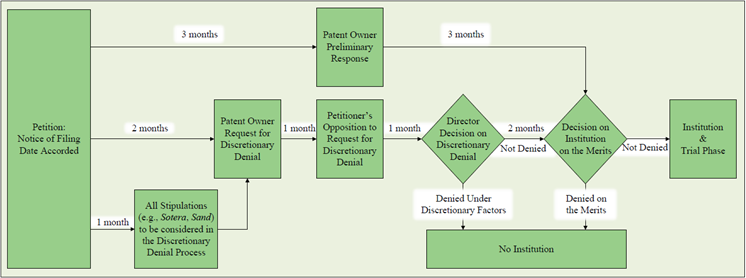
Under the new bifurcated discretionary denial process, the Director—after consulting with at least three senior APJs—will determine whether discretionary denial is appropriate. The Patent Owner chooses whether to engage in the new process. If the Patent Owner does, the Patent Owner Request for Discretionary Denial is due within two months of the NOFDA. The Petitioner’s Opposition is then due within one month of the Patent Owner’s brief. The Director will issue a written decision within one month of the Petitioner’s Opposition. In typical cases, with the parties and the Director taking full time allotted, this decision will come approximately one month after the due date for the Patent Owner’s Preliminary Response (POPR). Should the Director allow the petition to proceed to a decision on the merits, it will be assigned at this point to a merits panel of three APJs as normal, leaving two months for them to evaluate the petition.
Importantly, this timeline is all anchored to the filing date of Patent Owner’s brief. If the Patent Owner files early, Petitioners should not anticipate an extension. For instance, if the Patent Owner files its brief on the same day NOFDA is issued, the Petitioner’s opposition will be due one month later—effectively two months before Patent Owner’s deadline for the POPR.
Typical Case Timeline
The Merits Decision and Discretionary Denial Process are Separate
Through this new process, the USPTO is attempting to separate discretionary denial briefing from merits briefing. As such, the merits panel will no longer consider discretionary factors, even if the Patent Owner raises them in its POPR. The discretionary denial process will only be initiated if the Patent Owner files an opening brief raising those issues. If a Patent Owner believes discretionary denial is appropriate, it must raise those issues through the new procedure. Consequentially, Petitioners are also no longer expected to proactively address or “prebut” discretionary denial factors in a petition. However, one caveat to note is that it remains unclear if the Board will consider these arguments “waived,” or if the Director will still be able to raise them sua sponte.
Sotera, Sand, or Other Stipulations
Petitioners must file any stipulations (e.g., Sotera, Sand, or otherwise) within one month of the NOFDA for the stipulation to be considered in the discretionary denial process. This is so the Patent Owner can address any stipulations in its opening discretionary denial brief.
The impact of a stipulation follows PTAB precedent and guidance, as highlighted in Chief Judge Boalick’s recent memo on Finitv. However, the Director will consider whether the stipulation “materially reduces overlap” between the PTAB and parallel litigation. The example discussed during the Boardside Chat drew a distinction between printed prior art and system prior art, explaining that when a Petitioner relies on corresponding system art in a co-pending litigation, even a Sotera stipulation regarding overlapping printed prior art might not materially reduce overlap between the proceedings.
The Scope of the Discretionary Denial Process
As highlighted above, the new process is intended to remove all discretionary factors from consideration by the merits panel. As such, it includes all discretionary considerations, including §§ 314(a) and 325(d), and all the new factors outlined in the Discretionary Denial Memo.
There remain some questions, however, as to how the discretionary process can avoid the Director’s evaluation of the merits. Discretionary denial considerations of Fintiv Factor 6, as well as some aspects of § 325(d), have natural overlap with the overall merits of the petition. The Boardside Chat noted the PTAB would prefer the parties to include a concise version in the discretionary denial briefing, with reference to the more fulsome discussion and analysis in the merits briefing. How the parties can do this and not run afoul of rules against incorporation by reference remains unclear.
The Board was clear though it is looking out for gamesmanship by the parties. As such, Petitioners should not use discretionary denial briefing to sneak in extra merits arguments beyond the word limits of the petition. And Patent Owners should not use discretionary denial briefing to add additional merits arguments beyond the word limits of the POPR, nor should they use the POPR to try and relitigate discretionary issues to the merits panel.
Another interesting point made during the Boardside Chat was that Petitioners are not restricted to the scope of the Patent Owner’s brief and are free to address all discretionary denial factors in its opposition brief. Strategies will vary depending on the circumstances of the case, but Petitioners may be well served to consider addressing discretionary denial issues even if the Patent Owner does not specifically raise them.
Patent Owners may request a reply brief for good cause. Examples discussed during the Boardside Chat included new facts that are relevant to the briefing, e.g., changes to a court schedule or trial date, decisions on stays, or other court orders. Otherwise, it seems that parties should not expect a reply brief as a matter of course.
The Director’s Decision and Merits Panel Assignment
The Director will consult with at least three senior APJs and issue a decision within one month of the Petitioner’s opposition. The consulting APJs are expected to be selected based at least in part on subject matter expertise in the relevant technical field of the challenged patent, like the merits panel. However, the authority to decide will remain solely with the Director and will not be delegated to the consulting APJs or the merits panel. The Director will issue a written decision, accompanied by a supporting explanation, regardless of the decision on discretionary denial.
The merits panel will be assigned only after the Director decision. It will be a separate panel from the discretionary advisory panel, with no overlap or interaction regarding the case.
Institution Decision Reconsideration
A Director Review Request is the proper form of relief for parties seeking reconsideration of the Director’s decision on discretionary denial. A Request for Rehearing is appropriate only if the issues on reconsideration focus entirely on the merits. Reconsideration of the Director’s decision should be sought only after there are no more institution issues pending. Thus, if the Director does not discretionarily deny the petition, and the merits panel institutes, a Patent Owner seeking reconsideration should wait and pursue a Director Review addressing both merits and discretionary issues after institution. Conversely, if the Director does discretionarily deny the petition, a Petitioner seeking reconsideration should pursue a Director Review after that decision as no further decision on institution will be made.
Special Cases Timeline
The new bifurcated briefing applies to all pending IPR and PGR petitions that have not yet received an institution decision. In these cases, the PTAB has or will issue a notice extending the due dates as a matter of course.
In cases where the time for filing a discretionary denial brief has not yet elapsed but will elapse one month or less after March 26, 2025, the Patent Owner’s brief will be due no later than one month after the date of the extension, and the Petitioner’s opposition will be due no later than one month after the Patent Owner’s brief.
In cases where the time for filing a discretionary denial brief has elapsed but the deadline for filing a POPR has not elapsed as of March 26, 2025, the Patent Owner’s brief will be due by April 28, 2025, and the Petitioner’s opposition will be due one month after the Patent Owners brief.
General Logistics
The contact email for Discretionary Denial issues is Director_Discretionary_Decision@USPTO.gov. As with all communications to the Office, the requesting party must include the IPR or PGR number, identify the parties, and copy all counsel. This mailbox should be used for the following issues:
- Notifying the Director that a discretionary consideration brief was filed before April 14, 2025.
- Requesting good cause to file a reply brief or for other relief or issues related to discretionary review.
- Notifying the Director of substantial changes in litigation or new facts that implicate discretionary review.
- For any questions about the process not addressed by the Boardside Chat or the additional guidance and FAQs posted by the PTAB.
- To help the parties, the Board, and the public identify discretionary briefing, the PTAB has created new paper types in P-TACTS for filing the Patent Owner’s Opening Brief and the Petitioner’s Opposition.
Additional Answers to Come
The APJs stated they expect the PTAB will be providing more guidance soon, in at least the form of a list of FAQs. This additional guidance should hopefully answer more questions regarding the new process. For example, the APJs indicated it may answer questions regarding whether evidence can be included with the new briefing papers, or how factors like “the extent of the petitioner’s reliance on expert testimony” will impact the discretionary denial analysis. The Office also plans to pursue Notice and Comment Rulemaking after some time with the new procedure.
Tags
Patent Trial and Appeal Board (PTAB), Boardside Chat, Fintiv, filing date, United States Patent and Trademark Office (USPTO), patent owner, discretionary denials
Related Offices
Contacts


Copyright © 2025 Finnegan, Henderson, Farabow, Garrett & Dunner, LLP.
DISCLAIMER: Although we wish to hear from you, information exchanged in this blog cannot and does not create an attorney-client relationship. Please do not post any information that you consider to be personal or confidential. If you wish for Finnegan, Henderson, Farabow, Garrett & Dunner, LLP to consider representing you, in order to establish an attorney-client relationship you must first enter a written representation agreement with Finnegan. Contact us for additional information. One of our lawyers will be happy to discuss the possibility of representation with you. Additional disclaimer information.