
Statistics Show Patent Owners Concede Many Claims in IPR
December 17, 2014
Authored and Edited by Aaron L. Parker
Patent owners concede claims for many reasons—like tactical choice—or none, i.e., through procedural error. Common sense suggests self-cancelled claims would be rare. But a conservative estimate shows almost a tenth of all claims decided—and more than a tenth actually cancelled—were cancelled by choice. To date, almost two hundred claims—or just under eight percent—fell by patent owner’s concession in IPRs where a final written decision on the merits issued. (That does not include claims that were conceded prior to settlement and termination; likewise, those conceded claims do not include the myriad claims—and whole patents—cancelled via settlement agreement terminations or Requests for Adverse judgment.)
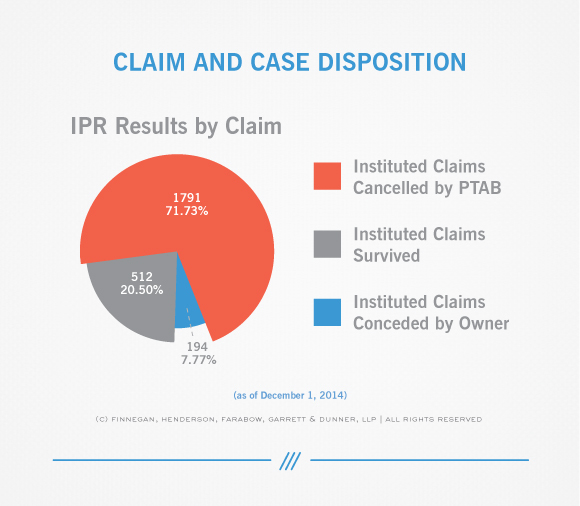
The percentage of claims conceded has fallen for the last two months—likely due to parties growing more familiar with the fast pace of IPR proceedings and learning through experience of the procedural pitfalls to avoid that could lead to unnecessarily conceding claims. Further, the PTAB has compressed the suggested Trial Practice Guide schedule from an initial nine-month-to-oral-hearing schedule, to a standard seven-month-to-oral-hearing schedule. The schedules in some IPRs have been even shorter.
Parties expecting an easy task juggling multiple due dates, adroitly filing, and accurately responding to the appropriate papers, conferences, and issues raised have their work cut out for them. A prepared and experienced PTAB team is a patent owner’s best defense against inadvertently conceding claims.
Contacts

Copyright © 2015 Finnegan, Henderson, Farabow, Garrett & Dunner, LLP.
DISCLAIMER: Although we wish to hear from you, information exchanged in this blog cannot and does not create an attorney-client relationship. Please do not post any information that you consider to be personal or confidential. If you wish for Finnegan, Henderson, Farabow, Garrett & Dunner, LLP to consider representing you, in order to establish an attorney-client relationship you must first enter a written representation agreement with Finnegan. Contact us for additional information. Additional disclaimer information.