
Working with OUII – The Staff Attorney’s Role and Practical Guidance on Interacting with the Staff Attorney
July 2023
LexisNexis Practical Guidance
By Mareesa A. Frederick; Reginald D. Lucas
This practice note covers the role of the International Trade Commission’s (ITC or Commission) Office of Unfair Import Investigations (OUII), an office unique to Section 337 investigations at the ITC. Section 337 investigations involve unfair practices in import trade under Section 337 of the Tariff Act of 1930 and allow a complainant to bring both statutory causes of action (e.g., civil causes of action such as patent infringement, created through legislation) and non-statutory causes of action (e.g., common law causes of action such as unregistered trade dress infringement). In addition to the complainant, as the IP rights holder, a Section 337 investigation also includes a respondent, the entity who imports products accused of violating Section 337. The trier of fact in these types of investigations is an administrative law judge (ALJ), and there is no jury. The final decision of the ALJ can be appealed to the Commission.
A Section 337 investigation also includes an additional party, the Office of Unfair Import Investigations (OUII), who represents the interests of the public (the ‘’public interest’’). The OUII is typically represented by one attorney, and this attorney is involved in nearly all aspects of an investigation, including fact and expert discovery, briefing related to discovery disputes, Markman briefing, fact and expert witness depositions, pre- and post-hearing briefing, opening statements at trial, and examination of trial witnesses. Historically, the OUII was a party in every investigation. But due to budget constraints and an increase in the number of investigations, the Commission decided in 2011 that OUII would reduce its role in accordance with its Strategic Human Capital Plan. Today the reduction includes:
- Not participating at all in a subset of Section 337 cases (those less likely to draw upon its expertise)
- Participating selectively in another subset of cases (on issues where it can provide the greatest added value and expertise)
- Fully participating in all other cases
See Adjudication and Enforcement, 76 Fed. Reg. 24363 (May 2, 2011); ITC, Supplement to the Strategic Human Capital Plan 2009–2013 (Jan. 2011).
OUII is more likely to participate in cases with significant issues unique to Section 337 (e.g., domestic industry or public interest) or with only limited respondent participation.
As will be explained herein, the OUII plays an important role in both the pre- and post- institution stages of a Section 337 proceeding, such as:
- Reviewing draft complaints before filing by complainant to determine whether the various issues are adequately pled before an investigation is instituted (For more on OUII review of draft complaints, see ITC Section 337 Investigations in Patent Infringement: Overview — Filing a Section 337 Complaint.)
- Advising the Commission on whether to institute investigations, regardless of whether it participates in a given case
- Reviewing complaint for compliance with the Commission’s pleading rules after an investigation is instituted
- Participating in discovery and mediating discovery disputes
- Representing the Commission at Markman hearings
- Representing the Commission at depositions and trial
For more guidance on ITC investigations generally, see ITC Complaint Filing Checklist, ITC Section 337 Investigations in Patent Infringement: Pre-suit Considerations, and ITC Section 337 Investigations in Patent Infringement: Overview.
Pre-institution OUII Involvement
Draft Complaint Review Meeting
Before a complainant files its complaint with the ITC, it may request an informal draft complaint review meeting with its counsel and OUII. Complainant and complainant’s counsel may attend. The draft complaint may be accompanied by exhibits providing the underlying proof for the alleged technical and economic prong of the domestic industry requirement, infringement, and the importation requirement. OUII ensures that the complaint complies with 19 C.F.R. §210.12 and identifies any pleading issues with the complaint, along with suggested changes. While OUII identifies pleading issues and issues with the complaint not complying with the Commission Rules, OUII does not, in any way, offer legal advice. For more background on preparing a Section 337 complaint, which may be much more complex than filing a district court complaint, see ITC Complaint Filing Checklist.
While the draft complaint review meeting is optional, approximately 95% of complainants request it. The meeting can be scheduled as an in-person meeting or a conference call (many draft complaint meetings have been held virtually due to the COVID-19 pandemic).
During the meeting, which typically lasts about an hour, the OUII may:
- Actively suggest improvements to the complaint, such as by recommending areas to highlight, rephrase, or shorten
- Discuss commission orders or case law relevant to the specific facts of the draft complaint
- Outline the differences in procedures and remedies between a Section 337 proceeding and a district court proceeding, if a litigant is a first-time complainant in a Section 337 investigation
The entire meeting is confidential, and OUII does not share any information with any individuals not attending the meeting. OUII ensures confidentiality and integrity of the draft complaint review meeting with the following procedure:
- Conducting the entire process off the record
- Not recording any discussion during the meeting
- Shredding the draft complaint after the meeting –and–
- Requiring the OUII attorney to recite a verbal disclaimer at the beginning of the meeting to affirm that:
- OUII will not attempt to advise how the case will be decided
- OUII will not provide an assessment of the merits of the case –and–
- OUII may take a position adverse to the complainant if OUII joins as a party to the case
Complainants can also resubmit draft complaints following OUII’s review for further comment. The OUII attorney who reviews your draft complaint may not be the OUII attorney assigned to your case. This should not affect the proceeding in any way, since this stage of interaction with OUII is only meant to make the pre-institution process easier (especially for first-time complainants) by highlighting any glaring issues in the draft complaint and providing complainants with a better understanding of Section 337 procedure.
Complaint Compliance Check
After complainant files the complaint, OUII conducts an in-depth detailed review of the complaint to ensure that it complies with the Commission Rules. Unlike with the complaint draft review process that occurs before the complaint is filed, no private parties may attend or participate in the complaint compliance check. Compliance at this stage is solely an institution function and is conducted in private by the OUII, with no input permitted by the private parties. The OUII uses a checklist including each provision of the Commission Rules and carefully ensures that the complaint complies with each provision. For example, Commission Rule 210.12(a)(6) states that if a complaint alleges a violation of the statute under Section 337(a)(1)(B)–(E) (e.g., patent infringement), a statement must be included in the complaint as to whether an alleged domestic industry exists or is in the process of being established. See 19 C.F.R. § 210(a)(6)(i). Carefully checking the text of the Rule, OUII would ensure that the complaint states whether a domestic industry exists or whether it is in the process of being established, as the Rule requires. Often a complainant who has taken advantage of OUII’s draft review process experiences less issues during the complaint compliance check. The ITC’s Rules are nuanced and it is important that litigants thoroughly read the Rules to ensure that the complaint complies with the Rules, especially if a complainant opts not to have a draft complaint review conducted.
For example, in pleading a non-statutory cause of action, such as trade secret misappropriation, Section 337 requires that a complainant show that its alleged domestic industry has been substantially injured. See 19 U.S.C. § 1337(a)(1)(A)(i). In showing substantial injury, however, the Commission Rules require that the complainant ‘’state a specific theory’’ and ‘’provide corroborating data’’ to support its allegation that its alleged domestic industry has been substantially injured. See 19 C.F.R. § 210.12(a)(8). Rule 210.12 particularly sets forth the ‘’information that should ordinarily be provided’’ in this respect, specifying the following information:
- The volume and trend of production, sales, and inventories of the involved domestic article
- A description of the facilities and number and type of workers employed in the production of the involved domestic article
- Profit-and-loss information covering overall operations and operations concerning the involved domestic article
- Pricing information with respect to the involved domestic article
- When available, volume and sales of imports –and–
- Other pertinent data
It is thus important that a complainant familiarize itself with the Commission Rules and be aware that the Commission requires detailed factual pleading in most instances. Although OUII carefully checks the complaint for compliance with the Commission Rules, OUII does not engage in any determinations as to whether the allegations in the complaint demonstrate a violation of Section 337. A determination as to the merits of the allegations in the complaint is reserved for the ALJ.
Recommendation of Delegation of the Public Interest before Institution
In every Section 337 investigation, the Commission considers whether the requested exclusion order or cease and desist order will negatively impact the public interest by considering the following four factors:
- The public health and welfare
- Competitive conditions in the S. economy
- The production of like or directly competition articles in the U.S. –and–
- U.S. consumers
19 U.S.C. § 1337(d)(1), (f)(1). The Commission’s determination as to whether the requested relief would adversely impact the public interest typically occurs at the end of an investigation. In some instances, the Commission orders the ALJ to take evidence and hear arguments from the parties or other interested parties with respect to the public interest and, as appropriate, provide the Commission with findings of fact and a recommended determination on whether the requested relief would negatively impact the public interest, as determined by the above-identified four factors. If the Commission does so, the Notice of Institution of Investigation specifies that the ALJ has been so ordered.
Although it is rare for the Commission to not grant the requested remedial relief due to its determined impact on the public interest, the Commission does, in fact, delegate the development of a factual record on the requisite public interest factors to the presiding ALJ in some instances, for example, in approximately 14 percent of the total new investigations for FY 2022. Consistently, the Commission Rules require each complaint to include a statement of public interest, addressing how issuance of the requested relief could affect the public interest factors. 19 C.F.R. § 210.8(b). The proposed respondents and members of the public may provide a response to complainant’s statement. 19 C.F.R. § 210.8(c).
During the complaint compliance check, the OUII carefully reviews complainant’s statement on the public interest and each statement on the public interest received from the proposed respondents and the public and makes a recommendation to the Commission as to whether it should delegate the issue of the public interest to the ALJ to authorize the ALJ to develop a factual record on the requisite public interest factors. Typically, OUII will recommend that the public interest be delegated if the technology identified in the complaint involves matters of health, for example, or other technology that may be vital to the public interest. For example, the Commission has delegated public interest when the complaint involves semiconductor technology in view of supply chain issues that have occurred over the past few years. A recommendation from OUII that the Commission delegate public interest to the ALJ, however, does not mean that the Commission will, in fact, delegate the public interest, although the Commission often follows OUII’s recommendation.
Post-institution OUII Involvement
OUII’s Many Post-investigation Roles
After the Notice of Institution is published in the Federal Register, the investigation has been officially instituted. OUII now participates as a third party representing the public interest. OUII has a number of roles after institution.
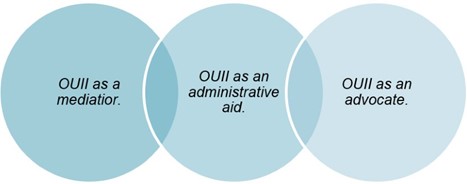
- OUII as a mediator (e.g., in resolving discovery disputes)
- OUII as an administrative aid (e.g., helps with understanding administrative procedures or ITC rule interpretation)
- OUII as an advocate (e.g., takes, supports, and argues a position)
In these roles, OUII helps to ensure that the investigation proceeds more efficiently without unnecessarily taxing the Commission’s resources, ensures that a complete record is developed, and that the public interest is adequately protected.
As part of its unique status in a Section 337 proceeding, there are some important things to remember about the OUII:
- Monetary sanctions for failing to produce or cooperate in discovery cannot be imposed against
- The OUII has the right to take discovery, respond to motions, examine witnesses, argue at Markman hearings, and present evidence at trial, just like counsel for private parties.
- The OUII is permitted, and often does, meet ex parte, with the private parties, unlike the ALJ.
OUII as Mediator
During discovery, the OUII often acts as a mediator and assists in resolving discovery disputes. OUII staff attorneys are intimately familiar with Section 337 proceedings, the Commission Rules (including the rules regarding discovery), and the various nuances in the ALJs’ ground rules. Not only is this knowledge invaluable, the staff attorneys have access to information from other investigations and regularly meet with their colleagues to discuss various discovery issues and the various resolutions adopted by the ALJs in other ongoing investigations. The combination of their knowledge and access to information in other investigations increases their effectiveness in mediating discovery disputes. Under the ground rules of most ALJs, if not all, parties are required to ‘’meet and confer’’ in an attempt to resolve discovery disputes. Although not required, each party may also meet separately with the assigned OUII attorney to discuss the dispute. Unlike the ALJ, the OUII attorney has no authority to decide a discovery dispute. The attorney can often determine exactly what information a party needs from another party and also determine why exactly a party may be resisting discovery in an attempt to reach compromise. The staff attorney often finds ‘’middle ground’’ while ensuring that each party essentially obtains what it needs. Although the staff attorney is often successful in helping the private parties resolve the discovery dispute, even if the attorney is not successful in this respect, an ex parte meeting with the attorney can often allow the private party to ‘’test’’ its arguments on an unbiased third party and to obtain invaluable feedback that can be used to strengthen its position before argument is presented to the ALJ.
Resolving such disputes through the OUII staff attorney instead of the ALJ can save the parties time that may be wasted on discovery motions and responses. But in the event that a discovery dispute is not resolved with the staff attorney’s help, the staff attorney will typically take a position on a discovery motion, and support its arguments in a response to the motion. The private parties may use OUII to resolve disputes in the following ways, for instance:
- Contacting the OUII attorney and providing the attorney with an overview of the private party’s arguments and affording the OUII attorney an opportunity to ask questions and to seek clarification regarding the disputed issues (either party (complainant or respondent) can reach out to the OUII attorney to discuss discovery disputes)
- Making sure that the OUII attorney has all of the information that the attorney needs to understand the dispute (i.e., discovery requests, documents, )
- Addressing opposing counsel’s position and anticipated arguments on the discovery dispute and providing the OUII attorney with an opportunity to ask questions
- Bringing to the OUII attorney’s attention relevant case law or support for particular important facts to assist the attorney with supporting a position
- Offering a follow-up call should the OUII attorney have additional questions after the meeting
OUII as Administrative Aid
The OUII can offer guidance on administrative issues, for example, issues regarding the interpretation of ITC rules or ambiguity in ITC case law. OUII staff attorneys have been involved in many cases over the years and have an abundance of wisdom, with some having served at the ITC for a number of years, in addition to having years of experience in private practice. The attorneys can also draw upon the wisdom and experience of all of the attorneys in the office, including supervisory attorneys. OUII can also offer information regarding a particular ALJ’s ground rules and the ALJ’s preferences.
OUII as Advocate
As an independent third party, OUII typically takes a position on all of the issues in the case, supporting and persuasively arguing its position via discovery briefs, Markman briefs, and pretrial and post-trial briefs. As an independent party without private client interests and demands, having OUII’s support on an issue(s), whether the issue is procedural or substantive, can have a powerful persuasive effect.
The following steps may be helpful in working with OUII in its role as an advocate:
- Offer to have the OUII attorney conduct a meeting with your technical expert for a technology overview and an overview of your position on major issues at the beginning of the investigation. Most of the OUII attorneys have technical backgrounds, but the OUII attorney assigned to your investigation may not be particularly familiar with the technology involved in the The meeting can thus be helpful in terms of providing the attorney with fundamental knowledge of the technology and an opportunity to ask questions regarding the technology and also to understand your position on the major issues in the investigation.
- Before expert witness depositions, meet with the OUII attorney to review the substantive issues in the investigation so the attorney will have a preview before attending a deposition and have any questions answered beforehand. One of the advantages of providing the attorney with an opportunity to answer questions before a deposition is that it may minimize or eliminate the need for the attorney to ask tricky questions during the deposition and thereby avoid opening the record up to unwanted questioning from opposing counsel. But OUII has a right to examine the witness during deposition and may ask any questions that it so desires during the deposition, regardless of whether it has an opportunity to ask questions of the witness before the deposition.
- Before OUII’s pre-hearing brief is submitted, offer a meeting with the OUII attorney to review all the issues in the case, including how the expert deposition testimony supports the litigant’s position on the technical issues in the case. Litigants should offer to send copies of key documents to OUII prior to the meeting. You can also offer to schedule the meeting over multiple days to accommodate the OUII’s attorney schedule.
Interacting with OUII at Various Post-institution Stages
Private parties should be sure to include the OUII in discussions at the various stages of the investigation after institution, for example, during the claim construction process, at the evidentiary hearing, and during the review process before the Commission. Regarding claim construction, while permitted, the OUII may not propose any claim terms for construction but will likely propose constructions for each term proposed for construction by the private parties. During a meet and confer with all of the parties, the OUII will typically assist the private parties with streamlining the number of claim terms proposed for construction and may also help the private parties find common ground in the various proposed constructions, which may result in the parties eliminating a claim term for construction or agreeing on a construction for a proposed claim term.
In addition to the meet and confer, each private party should consider having an ex parte meeting with the OUII to discuss its proposed constructions for each of the proposed claim terms. The OUII’s proposed construction may be similar to a proposed construction of a private party in some instances, and a private party may persuade the OUII to adopt its construction, or alternatively, the private party may adopt the OUII’s construction after the discussion after realizing that the differences between the two constructions are insignificant, for example. The private party may also use this meeting to test its arguments on a third party and obtain feedback on its arguments from the OUII. During the Markman hearing, each of the private parties should confer with the OUII because sometimes positions are clarified during argument, and a private party may sometimes decide to adopt the OUII’s proposed construction for a term or agree to another party’s construction after hearing oral argument on the proposed constructions.
At the evidentiary hearing, the private parties should be sure to include OUII in all meet and confers that happen at trial over evidentiary objections and the like. The ALJ will likely ask the parties if the OUII has been included in such discussions. You can also preview important evidentiary objections before meeting, and confer with OUII to obtain its position and address any issues of disagreement. Additionally, follow up with the OUII staff attorney prior to the submission of post-hearing briefing to determine whether the evidentiary hearing changed any views on the positions that the OUII may have taken in the investigation.
After the ALJ issues its final decision, known as the initial determination or ‘’ID,’’ the parties have an opportunity to appeal by submitting petitions for review on issues for which they did not prevail to the Commission. Prior to submitting petitions to the Commission, the private parties should check with the OUII attorney to determine whether the attorney intends to petition on any issues. Knowing whether the OUII plans to petition may assist the private party with planning in terms of how it will respond to the petitions of the other parties. Sometimes, OUII will not petition even if the ALJ has not adopted its view.
Conclusion
Section 337 investigations are unique in that the OUII serves as an additional party, representing the public interest. Litigants familiar with the various roles served by the OUII may gain an advantage over litigants who are not familiar with these roles. It is thus important for litigants to maximize their knowledge about the OUII and its various roles.
Related Offices
Related Professionals

Originally printed in LexisNexis in July 2023. This article is for informational purposes, is not intended to constitute legal advice, and may be considered advertising under applicable state laws. This article is only the opinion of the authors and is not attributable to Finnegan, Henderson, Farabow, Garrett & Dunner, LLP, or the firm’s clients.