
Unpacking the PTAB’s Patent Age Denial Doctrine Data
August 29, 2025
Intellectual Asset Management (IAM)

- Age-Based Eligibility for IPR Petitions: Patent Trial and Appeal Board’s new framework heavily emphasizes the "settled expectations" doctrine, with IPR petitions generally denied for patents older than six years and referred for younger patents.
- Guiding Principles for Petitioners and Patent Owners: Petitioners can counter the denial trend by demonstrating significant changes in law or lack of patent utilization, while patent owners can argue significant investment in recent patents to create settled expectations.
-
Practical Implications and Strategic Advice: Both parties must vigilantly monitor the emerging decisions under the "settled expectations" doctrine, as the contours of the doctrine and its interaction with other discretionary considerations are still developing.
The age of challenged patents has become a leading factor, if not the decisive factor, in determining whether inter partes review petitions will be denied.
On 26 March, Acting Director Coke Morgan Stewart finalised a new framework governing the Patent Trial and Appeal Board’s discretionary denial of institution in AIA proceedings by issuing the Interim Processes for PTAB Workload Management memorandum. Central to this framework is the introduction of the “settled expectations” doctrine, where the director will deny or refer a decision on institution primarily based on the age of the challenged patent.
We examine the contours of the new “settled expectations” doctrine, analyse its implementation in recent PTAB decisions and explore its implications for petitioners and patent owners navigating post-grant proceedings. Where patents are six years of age or older, IPRs are generally denied for settled expectations, but when patents are five years of age or younger, they are generally referred as “early challenges”.
However, Stewart has given guidance about arguments petitioners and patent owners can present to counteract this trend. For petitioners, significant changes in law or lack of utilisation of the patent may make settled expectations for an old patent inappropriate; for patent owners, significant investments may create settled expectations in young patents.
The Six-Year Threshold
Between 6 June and 22 August, there have been 249 decisions that considered the “settled expectations” doctrine, with 137 decisions supporting denial of institution and 112 decisions supporting institution. Those decisions are highly corelated with the ultimate result. Overall, 142 decisions of those cases were discretionarily denied institution, and 107 decisions proceeded to the merits.
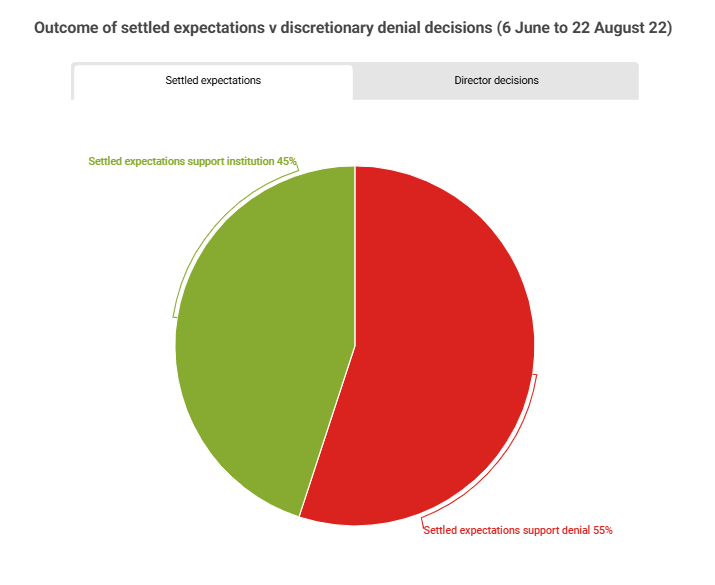
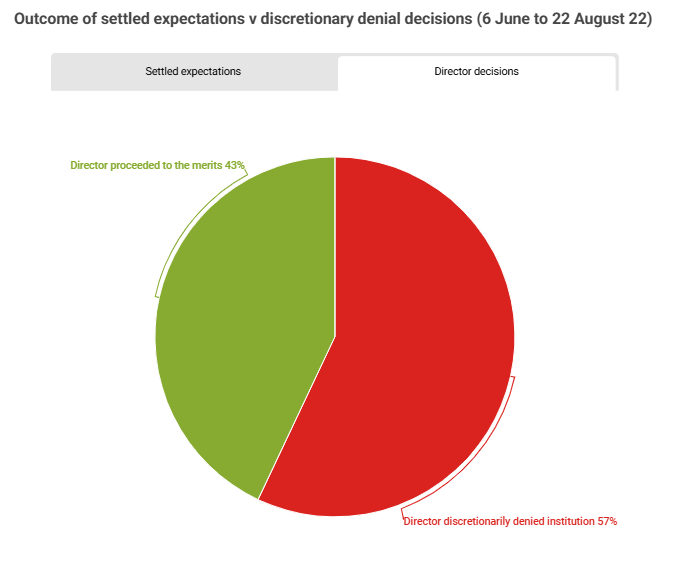
While settled expectations may not always be the deciding factor in discretionary denial decisions, it appears heavily weighed by the director.
To understand how the director is applying settled expectations, we analysed the age of patents in discretionary denial decisions and spotted a trend. For patents six years and older, the vast majority has settled expectations supporting denial. Conversely, for patents four years and younger, almost all supported referral for an institution decision. For five-year-old patents, the decisions remain split – most likely due to the patents being older at the time of the decision (the ages are based on IPR filing date).
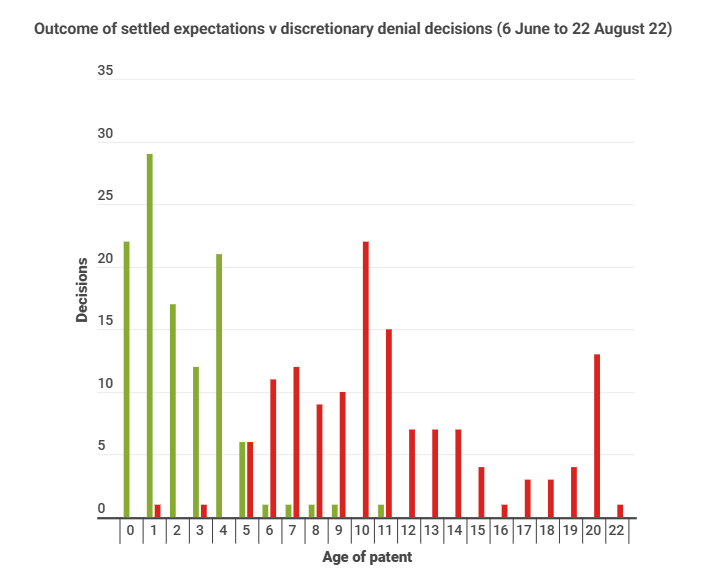
The chart above displays some outliers in the data, particularly for patents that were granted over six years ago. These cases provide valuable insights into what the director may consider in overcoming settled expectations:
- Globus Medical Inc v Spinelogik Inc: While the challenged patents were in force for almost eight and 11 years, the petitioner persuasively argued that the challenged patents expired almost four years ago due to non-payment of maintenance fees and the petitioner could not expect enforcement of the expired patents.
- Xencor Inc v Merus NV: For IPR2025-00604, the challenged patent was in force for almost nine years, but the petitioner overcame the strong settled expectations by presenting persuasive evidence that the “office erred in a manner material to the patentability of the challenged claims by overlooking teachings”.
- Shenzen Tuozhu Technology Co v Stratasys Inc: For IPR2025-00531, the challenged patent was in force for almost 10 years, but the petitioner presented persuasive evidence that the challenged patent was never “‘commercialized, asserted, marketed, licensed, or otherwise applied’ in the petitioner’s ‘particular technology space’”, consistent with Proxense (discussed below), which weighed against the strong settled expectations.
How to Argue Against Age
Although the “settled expectations” doctrine is based primarily on the age of the patent, recent decisions provide valuable insight into factors practitioners can argue to attempt to either defeat settled expectations for an older patent or create them for a younger patent.
On the petitioner side, in Intel Corp v Proxense, although the director granted the patent owner’s request for discretionary denial, she gave guidance about what arguments might defeat a patent owner’s settled expectations. The director highlighted two considerations:
- significant changes in law that may have occurred since the patent issued, and how the changes in law bears on the patentability of the challenged claims; and
- whether the challenged patent has been commercialised, asserted, marketed, licensed or applied in a petitioner’s technology space.
Similarly, the petitioner in BOE Technology Group Co v Optronic Sciences successfully argued that even though the challenged patents had been in force for approximately 12 years, the challenged patents were “directed to technology that is fundamentally different from what Petitioner uses in its products”, therefore the petitioner, “had no reason to challenge the claims of the patent” until the patent owner asserted them in the district court proceedings. The director credited the argument but ultimately denied on other grounds. Nevertheless, it remains a viable strategy petitioners should consider when arguing for referral of old patents.
Conversely, on the patent owner side, in Amgen Inc v Bristol-Myers Squibb Co the director gave guidance as to what patent owners could argue to create settled expectations for more recently-issued patents. Although the challenged patent in IPR2025-00603 was referred because it was only in force for three years, the director stated that the “amount of investment, time, and resources dedicated to research, development, trials, and regulatory approval” were factors that could have created settled expectations in that case and counseled denial. Patent owners should carefully lay out why the director should grant discretionary denial, especially if the challenged patent has not been in force for an extended period of time.
Practice Takeaways
Overall, petitioners should expect challenges in overcoming settled expectations once the challenged patent has been in force for over six years. However, petitioners can push back against settled expectations if, for example, there have been significant changes in law since the challenged patent issued or if the challenged patent had not been commercialised. Meanwhile, patent owners should take care to draft strong settled expectation arguments for patents, even if they have not reached the six-year mark, as the director will take a holistic approach at examining all factors of a challenged patent in determining whether institution should be denied.
Both petitioners and patent owners should keep in mind that the “settled expectations” doctrine has only been in force for a few months and should keep a sharp eye on future decisions to stay on top of the shifting landscape at the PTAB. Staying ahead means not only watching the clock on challenged patents but carefully tracking future decisions. In this evolving landscape, strategic timing may be the difference between institution and denial.
Tags
patent owner, Patent Trial and Appeal Board (PTAB), discretionary denials, settled expectations
Related Offices
Related Professionals



- Emma N. Ng
- Associate
- Washington, DC
- +1 202 408 4149
Originally printed in IAM on August 29, 2025. This article is for informational purposes, is not intended to constitute legal advice, and may be considered advertising under applicable state laws. This article is only the opinion of the authors and is not attributable to Finnegan, Henderson, Farabow, Garrett & Dunner, LLP, or the firm’s client.