
Paths to Successful Motions to Amend at PTAB
August 30, 2017
Law360
By Thomas Lee Irving; Barbara C. McCurdy; *Stacy D. Lewis
Patent owners continue to bemoan the extreme reluctance of the Patent Trial and Appeal Board to grant motions to amend substituting claims.
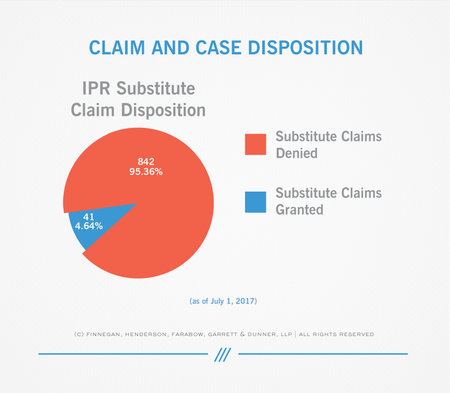
There is perhaps some hope for more leeway with the U.S. Patent and Trademark Office’s recent announcement that it is reviewing post-grant proceeding rules, including motions to amend practice. In addition the en banc Federal Circuit decision in In re Aqua Products Inc., 833 F.3d 1335 (Fed. Cir. Aug. 12, 2016), is pending,1 and that may also impact motions to amend in post-grant proceedings.
In the meantime, the very few motions to amend substituting claims that have been granted have involved patent owners expending significant effort to show PTAB how they meet all of the criteria set forth in the PTO rules and PTAB decisions.2
For example, in Global Tel*Link Corp. v. Securus Technologies Inc., IPR2015-01225, Paper 44 (P.T.A.B. Dec. 14, 2016), the PTAB granted the motion to amend to substitute claims with respect to all but two proposed substitute claims, finding that the patent owner narrowed the scope of original claims, showed written description support for the amended claims in the original disclosure, and showed patentability of the proposed substitute claims over prior art.
To support its motion to amend substituting claims in Global Tel*Link, the patent owner provided:
- detailed analysis and liberal citations to the original disclosure and prior art;
- expert declaration;
- explanation how the original disclosure supported the proposed substitute claims;
- a proposed level of ordinary skill in the art for the substitute claims;
- proposed claim constructions for some terms in the substitute claims.;
- detailed analysis regarding how each substitute claim is patentable over the prior art; and
- identification of the known closest art.
What made one of the most recent successful motion to amend cases interesting and somewhat surprising is that the patent owner did not supply that volume of material.
In Amerigen Pharmaceuticals Ltd. v. Shire LLC, IPR2015-02009,3 the patent owner did not file a patent owner response after institution, but rather proposed to substitute one claim and cancel all instituted claims. The original instituted claim included a dependency to any one of five claims, including three instituted claims. The proposed substitute claim canceled the claim dependency to the three instituted claims. In particular, the proposed substitute claim read:
26. The pharmaceutical composition of any one of claims 2[[,]] or 13 or 18 to 20 wherein the pharmaceutically active amphetamine salt in (a) and (b) comprises mixed amphetamine salts.
The two remaining claims, 2 and 13, were not instituted claims. In fact, claim 13 was not even challenged in the petition. The patent owner characterized its motion as one canceling claims rather than requesting entry of a substitute claim. As noted by the PTAB panel:
the practical effect of substituting proposed claim 26 (which depends from claim 2 or claim 13) for claim 25 would be to leave no instituted claim remaining in the trial.4
The petitioner protested that the patent owner had not met the requirements of Idle Free, such as demonstrating the patentability over the prior art of the proposed substitute claim. The PTAB rejected this argument, noting that Idle Free explained patent owner’s burden when the substitute claim includes a new feature. In contrast, in this case, the change only removed the dependency to instituted claims. The PTAB concluded:
We agree with Patent Owner that "[t]here is no requirement for Shire to prove, after the Institution Decision, that original non-amended claims are patentable over all potential prior art, especially non-instituted claims."5
The PTAB granted the patent owner’s motion to amend and entered this grant as a final written decision. No appeal was filed.
Another recent successful amendment case turned on objective evidence. In Valeo North America Inc. v. Schaeffler Tech. AG & Co. KG, IPR2016-00502,6 the patent owner filed a contingent motion to amend with its patent owner response, supported by a declaration and exhibits.7 That is, if instituted challenged claims 1-13 were found unpatentable, the patent owner proposed to substitute claims 14-25. Of note, proposed claims 19 and 25 were amended to recite a specific embodiment falling within the range recited in the independent claims. Key to the patent owner’s arguments of patentability of both the instituted challenged claims and the proposed substitute claims was objective evidence of unexpected results.
The PTAB found the petitioner established a prima facie case of obviousness of the instituted challenged claims. Then it considered the objective evidence of nonobviousness—the evidence of unexpected results. The petitioner argued there was no nexus, but the PTAB found that the patent owner was entitled to the presumption of nexus because it "adequately demonstrated that the system configuration it tested falls within the scope of the original claims."8 The patent owner ran into trouble though when the PTAB found that the unexpected results were not commensurate in scope with the instituted challenged claims, either in terms of other embodiments falling within the scope of the claims or within the claimed ranges.
Noting that the patent owner bore "the burden of proving that the substitute claims are patentably distinct over the prior art of record in the proceeding,"9 the PTAB turned to the contingent motion to amend. There was no dispute that the proposed substitute claims had written description support in the patent, and the PTAB held that the patent owner’s failure to provide a claim construction for each added term did not doom the motion to amend.10
While the substitute claim limitations were all found in the prior art, the patent owner made no patentability arguments other than those based on the objective evidence of unexpected results. According to the PTAB:
when we consider the substitute claims as a whole, we are persuaded that Schaeffler has shown adequately that the structures that allegedly yielded the unexpected results are reasonably commensurate with the structure recited in two of the substitute claims only, thus, establishing a nexus to those two claims only and rebutting any presumed nexus for the other claims.11
In particular, the unexpected results did not correspond to the recited ranges in six of the proposed substitute claims. But for two claims with specific claim limitations, the PTAB found a nexus existed. Moreover, "a showing of unexpected results in a claimed range outweighs a general assertion that optimizing a result-effective variable is within the routine skill in the art."12
The PTAB concluded that six of the proposed substitute claims were obvious and the patent owner’s objective evidence did not have the required nexus to overcome that conclusion.
For the two remaining proposed claims, however:
we are persuaded that Schaeffler has met its burden of showing that they are non-obvious over the prior art of record. In weighing the underlying factual evidence in this obviousness analysis, we find that the unexpected results evidence outweighs a relatively weak reason for combining Sudau, Eckel, and Speckhart.13
The petitioner’s other unpatentability arguments based on indefiniteness and §101 were rejected.
What is to be learned from these decisions? To be sure, they involve highly fact-specific examples, and whether a patent owner will have the opportunity to do something similar will depend on all facts and circumstances. But if analogous facts arise, a patent owner may find it worth considering the Amerigen "shortcut" out of an inter partes review or saving at least a couple of claims with objective evidence as in Valeo.
Even without applying the rationale of either of these cases specifically, patent owners may try and maintain protection of important subject matter by drafting patent applications including several claims with varying claim scope. Not only might this increase the likelihood that one or more patent claims will survive, it may minimize the necessity of amendment, probably still a more desirable and predictable route than turning to motions to amend and/or substitute claims.
In addition, any patents issuing from divisional applications may be protected in litigation from obviousness-type double patenting attacks based on parent application patents and could lead to several patents each having numerous claims of varying scope that a petitioner will have to challenge.
Another possibility to reduce the need to substitute/amend patent claims in an IPR is to keep a continuation application pending,14 bearing in mind, of course that any pending claim must be patentably distinct from a claim finally refused or canceled in an IPR to avoid the patent owner estoppel provision of 37 C.F.R. §42.73(d)(3). If the PTAB does not allow the patent owner to enter a particular proposed substitute claim, and if the subject matter of the proposed substitute claim is patentably distinct from any claims canceled in an IPR, such patentably distinct subject matter can still be pursued in a pending family member.
Endnotes
1 Questions to be briefed:
When the patent owner moves to amend its claims under 35 U.S.C. § 316(d), may the PTO require the patent owner to bear the burden of persuasion, or a burden of production, regarding patentability of the amended claims as a condition of allowing them?Which burdens are permitted under 35 U.S.C. § 316(e)?
When the petitioner does not challenge the patentability of a proposed amended claim, or the Board thinks the challenge is inadequate, may the Board sua sponte raise patentability challenges to such a claim? If so, where would the burden of persuasion, or a burden of production, lie?
2 http://www.uspto.gov/patents-application-process/appealing-patent-decisions/decisions-and-opinions/representative-orders#heading-4. In particular, the representative decision of MasterImage 3D, Inc. v. RealD Inc., IPR2015-00040, Paper 42 (P.T.A.B. July 15, 2015), by an expanded panel of 6 judges following and clarifying Idle Free Systems, Inc. v Bergstrom, Inc., IPR2012-00027, Paper 26 (P.T.A.B. June 11, 2013).
3 Amerigen Pharms. Ltd. v. Shire LLC, IPR2015-02009, Paper 38 (P.T.A.B. Mar. 31, 2017).
4 Amerigen, IPR2015-02009, Paper 38, at *5.
5 Amerigen, IPR2015-02009, Paper 38, at *6.
6 Valeo North America, Inc. v. Schaeffler Tech. AG & Co. KG, IPR2016-00502, Paper 37 (P.T.A.B. June 20, 2017).
7 Valeo, IPR2016-00502, Paper 14.
8 Valeo, IPR2016-00502, Paper 37 at 40.
9 Valeo, IPR2016-00502, Paper 37 at 56. The PTAB cited Microsoft Corp. v. Proxyconn, Inc., 789 F.3d 1292, 1307–08 (Fed. Cir. 2015); MasterImage 3D, Inc. v. RealD Inc., Case IPR2015–00040 (PTAB July 15, 2015) (Paper 42) (precedential); Idle Free Systems, Inc. v. Bergstrom, Inc., Case IPR2012–00027 (PTAB June 11, 2013) (Paper 26) (informative); but see In re Aqua Products, No.2015–1177, 2016 WL 4375651, at *1 (Fed. Cir. Aug. 12, 2016) (granting rehearing en banc to address burdens of persuasion and production regarding motions to amend under 35 U.S.C. § 316(d) and vacating In re Aqua Products, 823 F.3d 1369 (Fed. Cir. 2016)).
10 Valeo, IPR2016-00502, Paper 37 at 58-59.
11 Valeo, IPR2016-00502, Paper 37 at 66.
12 Valeo, IPR2016-00502, Paper 37 at 74.
13 Valeo, IPR2016-00502, Paper 37 at 76.
14 See, e.g., SteadyMed Ltd. v. United Therapeutics Corporation, IPR2016-00006, Paper 84 (P.T.A.B. April 6, 2017), where, after a Final Written Decision of unpatentability, the petitioner requested authorization to file a motion requesting cancellation of claims issuing from continuation applications as not being patentably distinct from the claims held unpatentable in the Final Written Decision. The PTAB denied the request because the claims issuing from continuation applications were not involved in the IPR.
*Stacy Lewis is a law clerk at Finnegan.
Related Professionals

Originally printed in Law360 on August 30, 2017. This article is for informational purposes, is not intended to constitute legal advice, and may be considered advertising under applicable state laws. This article is only the opinion of the authors and is not attributable to Finnegan, Henderson, Farabow, Garrett & Dunner, LLP, or the firm’s clients.

