
How New USPTO Guidance Fine-Tunes Fintiv Application
July 14, 2022
Law360
By Yieyie Yang, Ph.D.; Joshua L. Goldberg; Trenton A. Ward
On June 22, the U.S. Patent and Trademark Office issued guidance on an interim procedure for discretionary denials[1] noting the "potential for inefficiency and gamesmanship in the AIA proceedings."[2]
In 2020, the Patent Trial and Appeal Board designated the Fintiv case precedential in an attempt "[t]o minimize potential conflict between the PTAB and district court proceedings."
However, in the guidance, USPTO Director Kathi Vidal notes that "several clarifications need to be made to the PTAB's current application of Fintiv to discretionary institution where there is parallel litigation."[3] The memo provides that this guidance is binding on the PTAB, as it is issued under the director's authority to govern the PTAB's implementation of various statutory provisions.[4]
The Fintiv issue quickly became a hot topic raised in a significant number of PTAB cases after its precedential designation.
As illustrated in Figure 2 from the PTAB's recent parallel litigation study,[5] reproduced below, more than half of PTAB cases in the first quarter of 2022 raised the Fintiv issue.[6]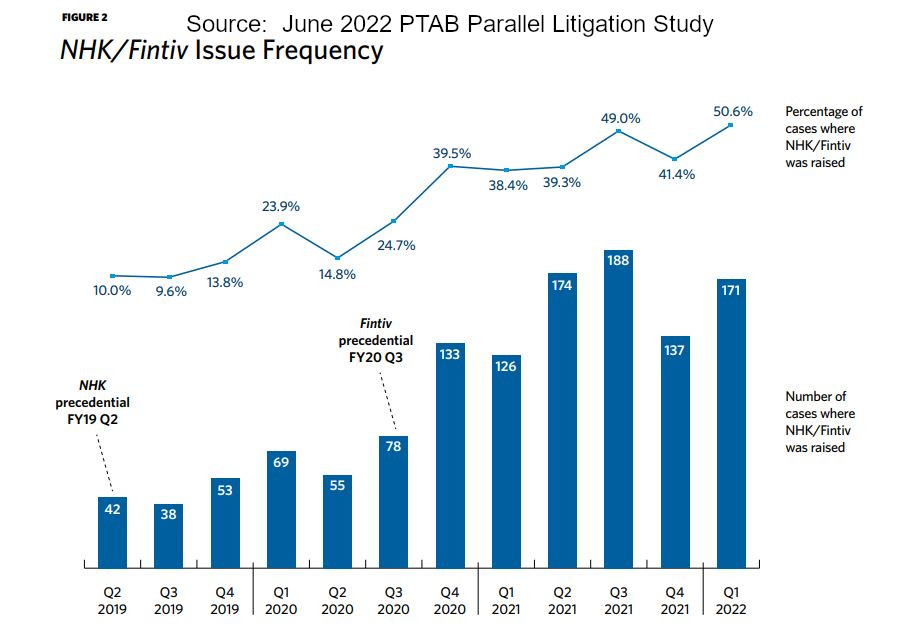
However, the PTAB's parallel litigation study also illustrates, in Figure 3 reproduced below, that the number of discretionary denials of institution based on Fintiv peaked in the second quarter of 2021, at 47 denials, and subsequently dropped to as low as six denials in the first quarter of 2022.[7]
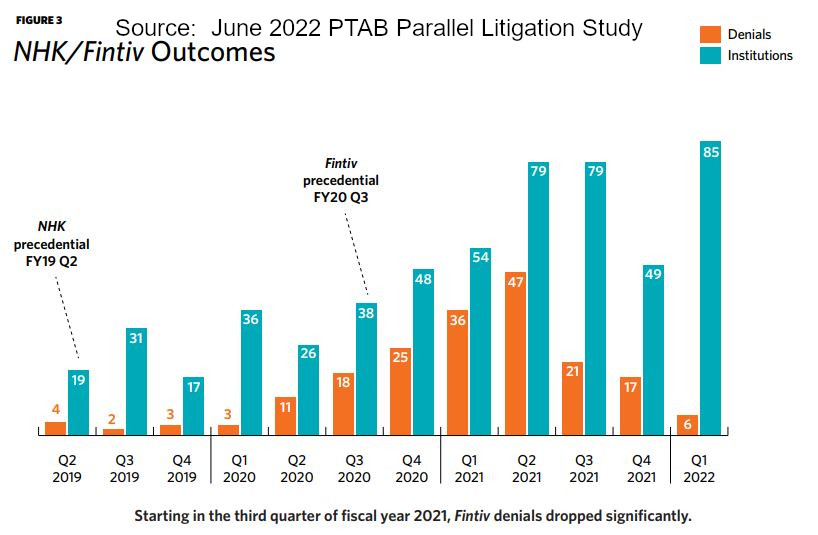
Now, in view of Vidal's guidance, we may see even fewer Fintiv denials as the guidance identifies scenarios in which the PTAB will not deny institution based on Fintiv. Specifically, the guidance provides that the "PTAB will not deny institution of an IPR or PGR under Fintiv" in the following scenarios:
- "When a petition presents compelling evidence of unpatentability,"
- "When a request for denial under Fintiv is based on a parallel ITC proceeding," and
- "Where a petitioner stipulates not to pursue in a parallel district court proceeding the same grounds as in the petition or any grounds that could have reasonably been raised in the petition."[8]
Compelling Challenges Will Not Be Denied Institution Under Fintiv
The guidance provides that if a compelling unpatentability challenge is presented in an inter partes review or post-grant review petition, "that determination alone demonstrates that the PTAB should not discretionarily deny institution under Fintiv."[9]
In support of this procedure, the memo states that Congress provided the office with significant power to revisit and revise earlier patent grants as a mechanism to improve patent quality.[10] Thus, "compelling, meritorious challenges will be allowed to proceed at the PTAB even where district court litigation is proceeding in parallel."[11]
During a PTAB webinar[12] on July 7, the PTAB panel further explained that compelling, meritorious challenges are "[c]hallenges in which the evidence, if unrebutted in trial, would plainly lead to a conclusion that one or more claims are unpatentable by a preponderance of the evidence."[13]
According to the webinar, the compelling evidence test affirms the PTAB's current approach of declining to deny institution under Fintiv where the evidence of record so far in the case would plainly lead to a conclusion that one or more claims are unpatentable.[14]
The webinar also explained that the compelling-merits standard is more demanding than the reasonable-likelihood and the more-likely-than-not standards for institution of an inter partes review or post-grant review, respectively.[15]
Fintiv Doesn't Apply to International Trade Commission Cases
Specifically, the guidance clarifies that Fintiv does not apply to U.S. International Trade Commission cases. The guidance notes that the PTAB's NHK Spring Co. precedential case considered a parallel district court proceeding and that the Fintiv factors "focus on the interplay between IPRs and district court litigation."[16]
Furthermore, the memo identifies differences between ITC investigations and district court patent litigation, including the fact that the ITC lacks the authority to invalidate a patent and its invalidity rulings are not binding on the USPTO or a district court.[17]
Because an ITC determination cannot conclusively resolve an assertion of patent invalidity, the guidance states that denying institution in favor of a parallel ITC investigation will not necessarily minimize conflicts with a PTAB proceeding or a district court proceeding. Thus, "the PTAB no longer discretionarily denies petitions based on applying Fintiv to a parallel ITC proceeding."[18]
Sotera Stipulations
If both the PTAB and a district court are adjudicating the same validity issues, it is possible that conflicting decisions could be rendered. Thus, factor 4 of Fintiv looks at the overlap between the issues raised in an inter partes review or post-grant review petition and a parallel district court proceeding.
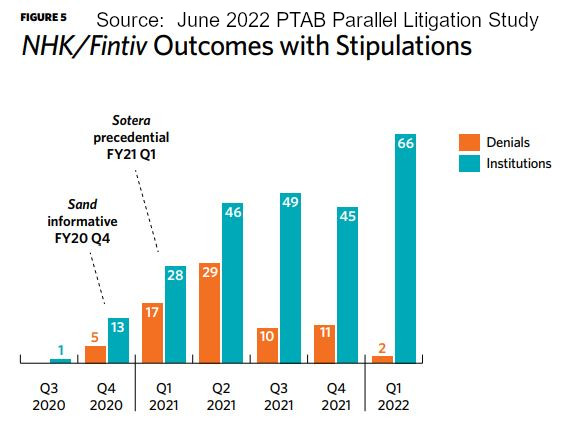
The guidance provides, however, that a stipulation by a petitioner that it will not pursue in district court litigation the same grounds as in the petition or that could have reasonably been raised in the petition — a Sotera stipulation — can mitigate the concern of potentially conflicting decisions.[19]
Thus, "the PTAB will not discretionarily deny institution of an IPR or PGR in view of parallel district court litigation where a petitioner stipulates not to pursue" grounds raised or that reasonably could have been raised in the petition.[20]
The guidance explains that this clarification avoids inconsistent outcomes between the PTAB and the district court and allows the PTAB to review grounds that the parallel district court litigation will not resolve.[21] The guidance is consistent with the statistics illustrated in the PTAB's parallel litigation study, as shown in Figure 5, reproduced below, that the Sotera decision "appears to have led to an increase in stipulation filings and a significant decrease in Fintiv denials."[22]
Consideration of Median Time-to-Trial Statistics
The PTAB's reliance on a district court's scheduled trial date for Fintiv consideration — Fintiv factor 2 — has been an issue that has drawn significant comment. The guidance acknowledges that when applying this factor, the PTAB has taken the court's trial schedules at face value absent some strong evidence to the contrary.[23]
The guidance provides that "[s]takeholders correctly noted that scheduled trial dates are unreliable and often change."[24] Thus, a district court's scheduled trial date, by itself, is not a good indicator of whether the PTAB's final written decision will be released before the district court trial.
The guidance provides that parties may present "median time-to-trial for civil actions in the district court" for the PTAB to consider.[25] The PTAB will also consider additional supporting factors such as the number of cases before the judge in the parallel litigation and the speed and availability of other case dispositions.[26]
Finally, the guidance provides that "even if the PTAB does not deny institution under Fintiv, it retains the right to deny institution for other reasons under 35 U.S.C. §§ 314(a), 324(a), and 325(d). For example, the PTAB may deny institution if other pertinent circumstances are present, such as abuse of process by a petitioner."[27]
[1] https://www.uspto.gov/sites/default/files/documents/interim_proc_discretionary_denials_aia_parallel_district_court_litigation_memo_20220621_.pdf. ("Guidance")
[2] Guidance at 1.
[3] Guidance at 2.
[4] Guidance at 3.
[5] https://www.uspto.gov/sites/default/files/documents/ptab_parallel_litigation_study_exec_summ_20220621_.pdf ("Study").
[6] Study at 3.
[7] Study at 4.
[8] Guidance at 9.
[9] Guidance at 5.
[10] Guidance at 4.
[11] Id.
[12] https://www.uspto.gov/sites/default/files/documents/PTABBoardsideChatDiscretionaryDenialsJuly2022.pdf.
[13] Id. at 13.
[14] Id.
[15] Id.
[16] Guidance at 5-6.
[17] Guidance at 6.
[18] Guidance at 7.
[19] Id.
[20] Id.
[21] Guidance at 7-8.
[22] Study at 5.
[23] Guidance at 8.
[24] Id.
[25] Guidance at 8-9.
[26] Guidance at 9.
[27] Id.
Tags
United States Patent and Trademark Office (USPTO), Fintiv, Patent Trial and Appeal Board (PTAB), International Trade Commission (ITC), discretionary denials
Related Offices
Related Professionals


Originally printed in Law360 on July 14, 2022. This article is for informational purposes, is not intended to constitute legal advice, and may be considered advertising under applicable state laws. This article is only the opinion of the authors and is not attributable to Finnegan, Henderson, Farabow, Garrett & Dunner, LLP, or the firm’s clients.
