
Finding Favorable Fora for Foreign Firms
May 9, 2023
IP Litigator
Why Patent Venue Matters
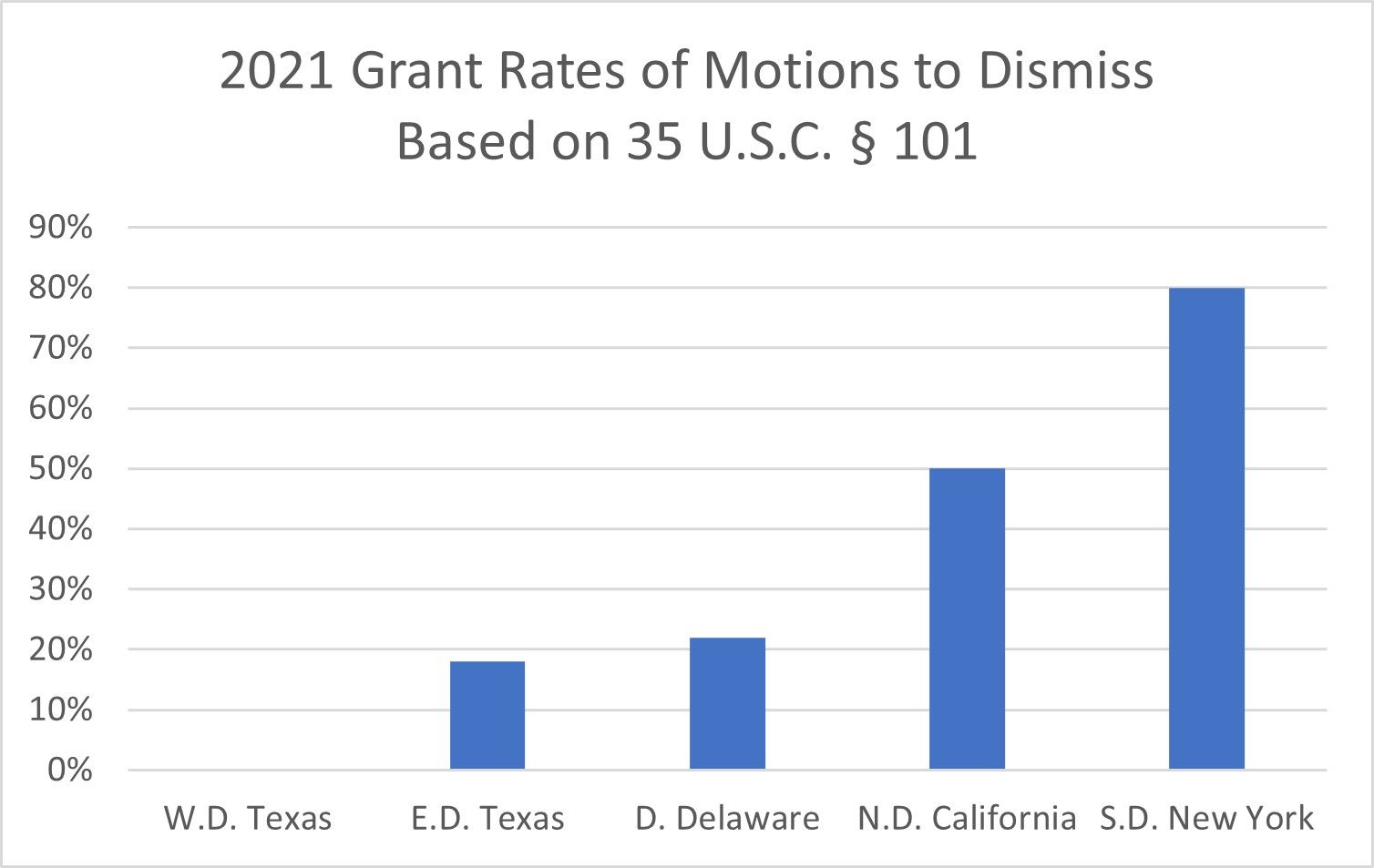
When it comes to patent cases, venue matters. As just one example, we noted in an article we published ear- lier this year that outcomes for early motions to dismiss based on patent eligibility differed among America’s five busiest district courts [2]:
Venue may also impact the ease of discovery and time- to-trial (2.1 years for Delaware vs. 2.6 years for Northern California) in patent cases.[3]
These differences come into play for American technology companies when considering the implications of where they have incorporated and set up office. Under a 2017 decision by the Supreme Court in TC Heartland LLC v. Kraft Foods Grp. Brands LLC, 137 S. Ct. 1514, 1517 (2017), a patent owner may only bring suit for patent infringement in the district where an American defendant (a) “resides” or (b) “has committed acts of infringement and has a regular and established place of business.”[4] In the years since TC Heartland, American defendants have used the Supreme Court’s holding to steer patent cases to their home districts (or places of incorporation). By August 2018, Northern California’s share of new patent suits had doubled (7.64% vs. 3.63%). The Eastern District of Texas, on the other hand, fell to less than half of its pre-TC Heartland traffic (14.97% vs. 39.01%). [5]
Venue Strategy for Foreign Corporations
But what about foreign firms doing business in the United States? According to a 2018 decision by the Federal Circuit (In re HTC Corp.), TC Heartland’s restrictions on proper venue do not directly extend to foreign corporations. Instead, per the court, “a defendant not resident in the United States may be sued in any judicial district.” [6] However, certain circumstances may still provide foreign firms a degree of control over venue in a patent case.
The American Subsidiary
Although TC Heartland may not cover foreign firms directly, it has been applied to American subsidiaries of those firms. If a patent owner wishes to sue a foreign firm and its American subsidiary, it must generally do so in the same district that the American subsidiary (i) is incorporated in (or “resides in”) or (ii) is headquartered.[7] A patent owner may sue only the foreign firm but there can be limitations in doing so. Often, the foreign parent isn’t the one alleged to be selling or making the allegedly patent-infringing products; the American subsidiary is.
Issues may also arise with discovery for a patent-owner seeking documents and information from a foreign entity. Courts may prohibit discovery of foreign entities where the production of documents is prohibited by the foreign firm’s host country. For instance, the Eastern District of Missouri recently denied a motion to compel production of documents from a Chinese defendant, crediting the defendant’s testimony that the request may “violate Chinese law” and granting the defendant additional time to resolve the issue. [8] This is not to suggest that plaintiffs can never obtain discovery from foreign defendants when foreign laws are implicated. Depending on the circumstances, courts may compel discovery even if it requires the violation of the foreign entity’s domestic law. [9]
The Motion to Transfer Based on “Convenience”
Even if a foreign defendant has no American presence, it may still influence the location of patent lawsuits brought against it based on convenience factors. Under 28 U.S.C. § 1404(a), a defendant to a patent suit may request a venue transfer to a “more convenient venue.”[10] Whether a new venue is “more convenient” than the one chosen by the patent owner depends on many factors, including (1) the location of documents and witnesses, (2) the familiarity of the forum with the law that will govern the case, and the (3) avoidance of conflicts of laws.[11]
The “convenience” approach to venue transfer is fact-dependent, but it is possible for a foreign defendant to argue for transfer to a different U.S. jurisdiction. For instance, in 2021, AudioEye Inc. brought a mixed lawsuit asserting both patent and non-patent claims against Israel-based AccessiBe in the Western District of Texas.[12] AccessiBe filed a motion before Judge Albright to transfer to the Western District of New York, arguing that (i) key witnesses were located in New York and (ii) the plaintiff’s non-patent claims invoked New York law. Judge Albright granted the motion, “giving weight to information that may reside in [the Plaintiff] AudioEye’s New York office,” and noting that “the WDNY may be able to compel” testimony of relevant New York witnesses, including the Plaintiff’s witnesses. [13]
Conclusion
Different districts have different outcomes in patent infringement cases. Defendants from overseas who find themselves in American courts may wish to consider their venue options based on their American subsidiaries, if any, or whether an alternative venue would be more convenient to the parties and witnesses.
Endnotes
- The authors are attorneys at the intellectual property firm of Finnegan, Henderson, Farabow, Garrett & Dunner LLP. This article is for informational purposes, is not intended to constitute legal advice, and may be consid- ered advertising under applicable state laws. This article is only the opinion of the authors and is not attributable to Finnegan, Henderson, Farabow, Garrett & Dunner LLP, or the firm’s clients.
- Alex Harding, Mareesa Frederick, Erika Arner and Daniel Cooley, As the Curtain Falls on CBM Review, What’s Next for Financial Institutions?, IP Litigator (March 2022).
- See PwC Patent Litigation Study Shows Recent Drop in Lawsuits Despite Increasing Patent Grants, IP Watchdog (Nov. 29, 2022, 3:21 PM), https:// com/2017/05/16/pwc-patent-litigation-study-drop-lawsuits/ id=83237/.
- 137 Ct. 1514, 1515-17 (2017).
- See The Impact of TC Heartland, docket NavIgator (Nov. 29, 2022, 3:21 PM), https://brochure.docketnavigator.com/tc-heartland/.
- In re HTC , 889 F.3d 1349, 1354-57 (Fed. Cir. 2018); see 28 U.S.C. §1391(c)(3) (emphasis added).
- See TC Heartland, 137 Ct. at 1515-18.
- Nidec Motor Corp. v. Broad Ocean Motor, LLC, No. 4:13-CV-01895-SEP, 2022 WL 4482431, at *4-6 (E.D. Mo. Sept. 27, 2022).
- Gucci , Inc. v. Weixing Li, 135 F. Supp. 3d 87, 88-94 (S.D.N.Y. 2015); see also Societe Nationale Industrielle Aerospatiale v. U.S. Dist. Ct. for S. Dist. of Iowa, 482 U.S. 522, 534 (1987) (outlining circumstances where first resort to discovery over foreign entities under the Hague Convention may not be required).
- See In re Volkswagen, Inc., 545 F.3d 304, 312 (5th Cir. 2008).
- See In re Volkswagen AG, 371 3d 201, 203 (5th Cir. 2004) (citing PiperAircraft Co. v. Reyno, 454 U.S. 235, 241 n.6 (1982))
- See AudioEye, Inc. v. accessiBe Ltd., No. 6:20-CV-997-ADA, 2022 WL 827805, at *1-5 (W.D. Tex. Mar. 9, 2022).
- See id.
Related Offices
Related Professionals


Originally printed in IP Litigator on May 9, 2023. This article is for informational purposes, is not intended to constitute legal advice, and may be considered advertising under applicable state laws. This article is only the opinion of the authors and is not attributable to Finnegan, Henderson, Farabow, Garrett & Dunner, LLP, or the firm’s clients.
