
After TC Heartland, Patent Owners Should Consider the Nuanced Standards in Other Districts Before Deciding Where to File
July/August 2017
IP Litigator
For years, the Eastern District of Texas has been a hot-bed for patent litigation, earning a reputation as a plaintiff-friendly district with plaintiff-friendly juries. Accordingly, as Exhibit 1 shows, the number of patent litigations in the Eastern District of Texas is disproportionally high.
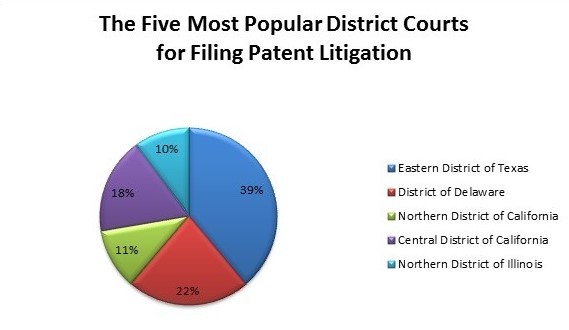
In TC Heartland LLC v. Kraft Foods Group Brands, LLC, however, the Supreme Court issued a ruling that likely will result in a sharp decline in the number of cases filed in the Eastern District of Texas. The Court ruled that patent infringement actions may be brought only in the district where the defendant is incorporated, or where the defendant has committed acts of infringement and has a regular and established place of business.1 Plaintiffs unable to meet this standard in Texas will be forced to look to other districts across the country, which often have nuanced rules for patent cases. This article highlights some of these nuanced rules, which, if not understood at the outset, can have a profound impact on the outcome of the case.
Variety in Pleading Standards
It used to be (in many courts) that a complaint identifying an asserted patent and an accused product was sufficient to survive a motion dismiss. The Supreme Court, in the Twombly-Iqbal2 line of cases, however, heightened the pleading requirements and made it easier for defendants to prevail at the motion to dismiss stage. Recent modifications to the Federal Rules of Civil Procedure leave no doubt that the Twombly-Iqbal precedent applies to patent cases.
Nuances have developed across the country in pleading requirements as district courts have grappled with these new legal standards. For instance, the Northern District of California has held that a complaint "largely tack[ing] the language of the claims" could suffice under the Twombly-Iqbal standard.3 But it also has held that "simply reciting some of the elements of a representative claim and then describing generally how an accused product operates, without specifically tying the operation to any asserted claim or addressing all of the claim requirements, is insufficient."4 In the Eastern District of Texas, the level of specificity necessary at the pleading stage can turn on the complexity of the invention. "Cases involving tangible inventions … may require less detail to state a claim" whereas "more nebulous, less tangible inventions … may require a higher degree of specificity to provide proper notice to the defendant."5
It appears that some districts do not require a plaintiff to specify asserted claims in the complaint. For example, the Central District of California allowed a claim to proceed even though the complaint only attached the asserted patent, identified the accused products by name, and generally compared the technology disclosed in the patent to the accused products.6 In Delaware, a more lenient pleading standard may apply when the information necessary to determine infringement is not publicly accessible.7
These disparate pleading standards can have a significant impact on how a case is litigated. Forcing the plaintiff to provide more specificity at the pleading stage allows a defendant to make more targeted noninfringement and invalidity arguments early in the case. The added specificity in the pleadings pins the plaintiffs down early and leaves them with less room to navigate around the defendant’s theories as they unfold throughout the case. Thus, plaintiffs should carefully examine the rulings on pleading requirements from the specific district before deciding where to file—and then plead no more than is necessary.
Claim Construction Differences
District courts have authority to limit both the number of claim terms to be construed and the number of asserted claims in patent cases.8 In exercising this authority, courts consider such factors as: the feasibility of trying the claims to a jury, whether the patents in suit share common genealogy, whether the patents contain terminal disclaimers, and whether the asserted claims are duplicative.9
Courts vary in how many claims can be proposed for construction. The Eastern District of Texas, by comparison to other courts, allows a high number of proposed claims for construction—10 claims for each patent and up to 32 claims overall.10 In some instances, the court has allowed construction for 15 claims from each patent and 48 claims overall.11
Other districts require much less. The Northern District of Illinois requires parties "to meet and confer and agree upon no more than 10 terms or phrases to submit for claim construction."12 In the event that the parties cannot agree upon 10 terms, the court will allocate five terms or phrases to all plaintiffs and five terms or phrases to all defendants.13 The Northern District of California requires the parties to jointly identify 10 terms that are most significant to resolving the dispute.14 If the parties cannot agree on the 10 most significant terms, they shall identify which terms are agreed on and then evenly divide the remainder.15 Under this arrangement, if the parties agree on five terms, each party may only identify two additional terms (nine terms in total).16
The number of claims allowed for construction is an important factor in any patent case. In most instances, plaintiffs prefer few terms for construction, because this makes proving infringement easier. In contrast, when a court allows a high number of proposed terms for construction, the defendant has a better opportunity to obtain a claim construction ruling that results in an invalidity or noninfringement finding.
Possible Legislation
It appears Congress supports the Supreme Court’s decision in TC Heartland. Senator Orrin Hatch has noted that, "[N]o matter what the Court does, we’re likely going to need follow-on legislation to prevent future forum-shopping and to ensure that litigants have a meaningful connection to the site of the suit."17 The Chairman of the House Judiciary Committee, Congressman Bob Goodlatte, shares a similar agenda regarding patent reform.18
Conclusion
After TC Heartland, plaintiffs will be forced to find other forums besides the Eastern District of Texas. In doing so, attorneys should be mindful of nuanced procedural rules such as those described above before deciding where to file, and of how those rules can impact the substantive aspects of the case.
Endnotes
1 TC Heartland LLC v. Kraft Foods Group Brands LLC, 581 U.S. __ (2017).
2 Bell Atl. Corp. v. Twombly, 550 U.S. 544 (2007); Ashcroft v. Iqbal, 556 U.S. 662 (2009).
3 Avago Techs. Gen. IP (Singapore) PTE Ltd. v. Asustek Computer, Inc., 2016 WL 1623920, at *4 (N.D. Cal. Apr. 25, 2016).
4 Atlas IP LLC v. Pac. Gas & Elec. Co., No. 15-cv-05469-EDL, 2016 WL 1719545, at *2 (N.D. Cal. Mar. 9, 2016).
5 Uniloc USA, Inc. v. Avaya, Inc., No. 6:15-cv-1168-JRG, Dkt. 48, at *7 (E.D. Tex. May 13, 2016) (quoting Patent Harbor, LLC v. DreamWorks Animation SKG, Inc., No. 6:11-cv-229, 2012 U.S. Dist. LEXIS 114199, at *13 (E.D. Tex. July 27, 2012)).
6 Incom Corp. v. Walt Disney Co., No. 2:15-cv-03011-PSG-MRW, Dkt. 39, at *4 (C.D. Cal. Feb. 4, 2016).
7 DermaFocus LLC v. Ulthera, Inc., 2016 WL 4263122 (D. Del. Aug. 11, 2016); K–Tech Telecommunications, Inc. v. Time Warner Cable, Inc., 714 F.3d 1277, 1286 (Fed. Cir. 2013) (stating that "[a] defendant cannot shield itself from a complaint … by operating in such secrecy that the filing of a complaint itself is impossible").
8 See Nuance Commc’ns, Inc. v. ABBYY USA Software House, Inc., 813 F.3d 1368, 1376 (Fed. Cir. 2016) (noting that patent owners are allowed to show why additional claims are needed to satisfy due process).
9 Thought, Inc. v. Oracle Corp., No. 12-CV-05601-WHO, 2013 WL 5587559, at *2 (N.D. Cal. Oct. 10, 2013) (citing In re Katz, 639 F.3d 1303, 1311 (Fed. Cir. 2011)).
10 See Script Security Solutions, L.L.C. v. Amazon.com, Inc., No. 2:15-cv-1030-JRG, Order Focusing Patent Claims and Prior Art to Reduce Costs (Nov. 19, 2015); see also Blue Spike, LLC v. Contixo, Inc., No. 6:16-cv-1220-RWS-JDL, Order Focusing Patent Claims and Prior Art to Reduce Costs (May 17, 2017).
11 See Ericsson Inc. v. Apple Inc., No. 2:15-cv-288-JRG-RSP, Ordering Focusing Patent Claims and Prior Art (Aug. 31, 2015).
12 N.D. IL. LPR 4.1.
13 Id.
14 N.D. CA. LPR 4-1.
15 N.D. CA. LPR 4-3.
16 Id.
17 Hatch Unveils Innovation Agenda for the 115th Congress, https://www.hatch.senate.gov/public/index.cfm/releases?ID=EFD3D177-610E-4255-B302-C0A0114F4268.
18 Goodlatte pledges to pursue patent litigation reform, copyright reform in 115th Congress, http://www.ipwatchdog.com/2017/02/01/goodlatte-patent-litigation-reform-copyright-reform/id=77879/; Congress Continues to See Need to Reduce Abusive Patent Litigation, https://patentlyo.com/patent/2017/05/congress-continues-litigation.html.
Related Practices
Related Professionals

Originally printed in IP Litigator on July/August 2017. This article is for informational purposes, is not intended to constitute legal advice, and may be considered advertising under applicable state laws. This article is only the opinion of the authors and is not attributable to Finnegan, Henderson, Farabow, Garrett & Dunner, LLP, or the firm’s clients.