
July/August 2010 Issue
Civil Cases
Specialized Seating, Inc. v. Greenwich Indus., LP,
2010 WL 3155922 (7th Cir. Aug. 11, 2010)
ABSTRACT
The Seventh Circuit affirmed the district court’s ruling that the declaratory-judgment defendant’s registered design for an x-frame chair was functional and thus unprotectable. Although the registration was incontestable, it was still subject to attack based on functionality. The court found that four expired utility patents owned by the declaratory-judgment defendant covered all the features of the chair, except for one element that had been improved upon for a functional purpose. The court recognized that many alternative designs existed, but found that this was not dispositive of the functionality determination where those alternate designs were also functional and simply represented different solutions to the same functional-design problem.
CASE SUMMARY
FACTS
Greenwich Industries, LP (“Greenwich”) has been making x-frame folding chairs for eighty years. In 1999, it applied to register one particular x-frame design as a trademark, and the PTO issued a registration for the following mark in 2004:
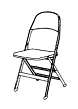
Following the departure of a Greenwich employee to competitor Specialized Seating, Inc. (“Specialized”), Specialized began selling a folding chair that closely resembled Greenwich’s trademarked chair in its basic design. A dispute arose, and Specialized sought a declaratory judgment that its design does not violate Greenwich’s rights under the Lanham Act, while Greenwich counterclaimed for an injunction.
Following a bench trial, the district court ruled in Specialized’s favor, finding that the x-frame construction is functional because it was designed to be an optimal tradeoff between the chair’s weight (and thus its cost, since lighter chairs use less steel) and its strength. The district court also found that an x-frame chair folds itself naturally when knocked over; that the flat channel at the seat’s edge, where the attachment to the frame slides so that the chair can fold, was designed for strength and for attaching hooks to link a chair with its nearest neighbor; and that the front and back cross bars contribute strength. In addition, the district court found that the newer “b-back” design used in the chair (and depicted in the registration) allows the chair to support greater vertical loads than Greenwich’s older “a-back” design, and provided various other benefits. Based upon all of these determinations, the district court concluded that the x-frame construction was functional and unprotectable, and cancelled Greenwich’s registration.
The district judge also found that Greenwich had defrauded the PTO. The examiner had initially refused to register the design as a trademark because the design appeared to be functional. Greenwich replied that the design was chosen for aesthetic rather than functional reasons, and that a patent it held on an x-frame chair, issued in 1934, did not include all of the features in the mark’s design. Greenwich failed to inform the examiner that it held three other expired patents on the x-frame design. The district judge concluded that the four patents collectively covered every feature of the design except the b-back, and that as the b-back is a functional improvement over the a-back, Greenwich should have disclosed all of these utility patents (which, the district court believed, would have resulted in rejection of its application).
ANALYSIS
The Seventh Circuit began by noting that Greenwich’s registration is “incontestable,” but that the word “incontestable” is “misleading,” because an incontestable mark may be contested—and defeated—on multiple grounds, including functionality and fraud.
The Circuit Court reviewed the standard of review applicable to the district court’s functionality finding, noting that findings of fact made after a bench trial must stand unless clearly erroneous. The court explained that “functionality” is not an issue of law, as it represents a fact-specific conclusion about whether aspects of a design are “essential to the use or purpose of the article or if it affects the cost or quality of the article.” Accordingly, the clearly erroneous standard applied.
Greenwich argued that the district judge’s findings were influenced by legal errors, but the Seventh Circuit did not agree. The Circuit Court referenced the Supreme Court’s TrafFix decision holding that claims in an expired utility patent are presumptively functional and that, since inventions covered by utility patents pass into the public domain when the patent expires, it is inappropriate to use trademark law to afford extended protection to a patented invention. The appellate court concluded that the lower court did not commit clear error in finding that Greenwich’s utility patents disclosed every aspect of the asserted trademark design except for the b-back, and that the b-back design is a functional improvement over the a-back design. In other words, “[the chair] looks the way it does in order to be a better chair, not in order to be a better way of identifying who made it (the function of a trademark).”
Further, the Circuit Court agreed with the district court that the mere availability of alternate designs is not enough to defeat a functionality claim, as one of the rationales of the functionality doctrine is to prevent firms from appropriating basic forms that go into many designs. Thus, preserving basic elements for the public domain is not the functionality doctrine’s only role. Rather, as TrafFix stressed, another goal of the functionality doctrine is to separate the spheres of patent and trademark law, and to ensure that the term of a patent is not extended beyond the period authorized by the legislature. The appeals court agreed with the lower court’s finding that a design such as Greenwich’s x-frame chair is functional not because it is the only way to do things, but because it represents one of many solutions to a problem.
Greenwich argued that other designs are stronger, or thinner, or less likely to collapse when someone sits on the backrest, or lighter and so easier to carry and set up. While granting that the list of alternative designs was very long, the court found that this means only that all of those designs are functional, in the sense that they represent different compromises along the axes of weight, strength, kind of material, ease of setup, ability to connect the chairs, and so on. A novel or distinctive selection of attributes on these many dimensions can be protected for a time by a utility patent or a design patent, but it cannot be protected forever as one producer’s trade dress. Instead, when the patent expires, other firms should be free to copy the design to the last detail in order to increase competition and drive down the price that consumers pay.
Greenwich cited cases holding that a product whose overall appearance is distinctive can be protected under the trademark laws, even though most of the product’s constituent elements serve some function. In each such case, the court noted that what made the appearance “distinctive” was a nonfunctional aspect of the design.
Finally, the Seventh Circuit found that because the district court did not commit clear error in finding Greenwich’s design to be functional, it was unnecessary to decide whether Greenwich committed fraud on the PTO. Greenwich expressed concern that the district judge’s finding of fraud might affect future litigation against a different competitor. In response, the Court stated that issue preclusion (collateral estoppel) applies only to issues actually and necessarily resolved in the first case. In this case, it was not necessary for the district court to address fraud on the PTO, so the district court’s opinion on this subject should not have preclusive effect.
CONCLUSION
This decision highlights the importance that expired utility patents can have on a functionality analysis applied to a trademarked design. It also shows that a common argument against a finding of functionality, namely, that alternate designs are available, may not succeed if those alternate designs are simply alternate functional designs that represent a different balance of functional elements to achieve the same functional goal.
